

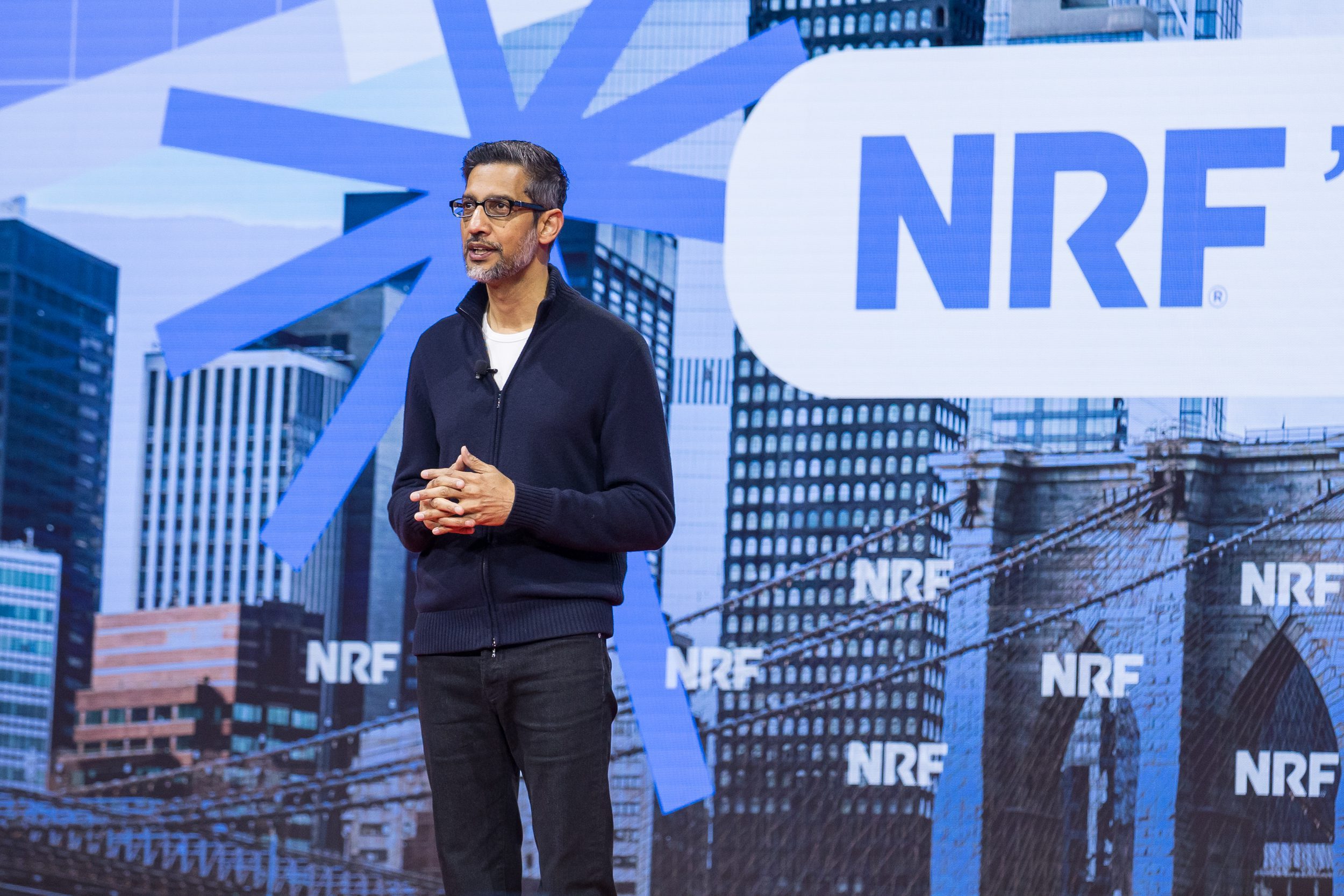
When Google CEO Sundar Pichai took the stage at the NRF Big Show last month it was a watershed moment. More than any specific thing he said, the mere fact of Pichai’s presence at that particular event spoke volumes.
“This is the first time Sundar has come to NRF, actually,” shared Anil Patel, who leads the Global Strategic Industries team in Google’s Cloud division on this week’s episode of Retail Remix. “He felt, and his team felt, that this was a really important moment for us as we talk about the rise and emergence of agentic shopping and agentic commerce.”
An important moment indeed as the tech giants find themselves in a pitched battle to own the next major epoch of technological advancement, potentially as pivotal as the dawn of the internet. Pichar’s keynote address at the retail industry’s largest and most influential trade show made it crystal clear that commerce is right smack in the center of the battle to own the AI Era.
Pichar used the moment to make a series of major announcements, the most consequential of which was the debut of its Universal Commerce Protocol, enabling direct checkout in Google AI Mode and Gemini. It was a development that those paying close attention likely saw coming from a mile away — OpenAI debuted ChatGPT Instant Checkout in September 2025, Microsoft rolled out its own Copilot Checkout in early January just prior to Pichai’s keynote, and Perplexity kicked it all off with Shop Like a Pro in November 2024.
Google’s AI-Prompted About-Face
But while the debut of in-platform checkout on Google may, from the outside, have looked like a foregone conclusion, for Google the decision represents more than just a natural evolution. Rather, it’s a reversal of long-held ideals about its role in the commerce ecosystem. And that, more than anything, may be a signal of how deeply AI is already reshaping our world.
Shopping has been a central activity on Google since the dawn of ecommerce, but throughout the decades Google has steadfastly resisted being anything more than a conduit for those searches. Even as it worked to build up its slate of product listings in a bid to combat the search traffic competition from third-party marketplaces like Amazon, Google persistently reassured retailers and the world that its goal was not to become a marketplace itself.
“We’re indifferent on where the shopping journey ends, where that transaction takes place,” said Matt Madrigal, then-VP and General Manager of Merchant Shopping at Google in a 2021 interview with Retail TouchPoints.
“We’re not a retailer, we’re not a marketplace,” said then-Google Commerce President Bill Ready that same year on the Modern Retail podcast. “What we do want to do is make sure that on a Google surface, the user can discover the best products, the best values, the best sellers, and then seamlessly connect to those sellers. Most of the time, that actually means clicking out to that seller’s own website; it is not our goal to necessarily keep the user on our platform.”
Of course, the world has changed dramatically since 2021. Now Google’s biggest existential threat isn’t Amazon or TikTok, it’s the new cohort of AI answer engines — ChatGPT, Copilot and their ilk. Google has quickly responded with its own AI-powered offerings, which include its standalone answer engine Gemini, but also the introduction of AI-generated answers in general Google queries.
Across the board, these new AI platforms are so skilled at understanding natural language queries and making recommendations that they have, in a very short period of time, completely upended the mechanics of shopping online. As Google’s AI competitors have swiftly moved beyond simply suggesting what to buy and become the place to buy it, Google almost had no choice but to respond in kind. And so, after years of insisting that it didn’t want to handle the transaction moment, Google has begun building the capabilities to do just that.
With AI Commerce, Familiar Fears are Resurfacing
All of this has, of course, raised big questions among retailers about how to respond, and the varied reactions feel very similar to the Amazon/marketplace conversation of five years ago. At one point in time, it was very much à la mode to resist selling on Amazon at all costs. On the flip side of that coin, many major retailers absolutely refused to consider adding their own third-party marketplaces.
Yet now, both practices are seen as widely accepted, even advisable, to compete in the crowded ecommerce landscape: Gap, Victoria’s Secret, Nike and many other brands can now be found on Amazon, and the list of major retailers with a third-party marketplace is likely longer than the list of those without one at this point.
Retailers’ biggest fears around marketplaces involved brand dilution and an erosion of their ability to own the customer relationship, and those fears are resurfacing with the rise of AI answer engine checkout.
Some merchants seem to have taken a lesson from the marketplace days and are moving swiftly to ensure they’re part of this new realm of ecommerce, including Walmart, Target, Etsy, Wayfair, Lowe’s, Macy’s, Ulta Beauty and Best Buy. Others have reacted defensively, actively working to block these AI platforms from their sites. Ebay just made updates to block third-party AI agents and, interestingly, Amazon now finds itself in the defensive position, actively blocking OpenAI and Perplexity from crawling its site, although that position may be wavering.
Commerce Becomes the Flashpoint in the AI Battle
If transactional AI follows the industry’s embrace of marketplaces, it’s likely that eventually nearly everyone (except the companies big enough to build their own, like perhaps Amazon) will give in to the gravitational force of consumer demand and join the AI answer engines.
As for which one of those answer engines will win out among consumers, the race is still on, and the frontline of that battle at the moment is ecommerce.
It makes sense that shopping would become a flashpoint in this contest — commerce-related queries make up a huge chunk of the traffic in general search and have the added benefit of attached revenue, something that cash-burning tech enterprises like OpenAI desperately need right now.
While online shopping revenue on third-party platforms has typically taken the form of fees or affiliate commissions, when the transaction takes place within a search platform there’s also the chance for a cut of the sale. ChatGPT has moved in that direction with plans to charge 4% on all transactions that happen through Instant Checkout.
At one point many years ago, Google tried to charge commissions and fees for Google Shopping listings but eventually dropped that in lieu of simply getting the listings on its platform, because (and we’d be remiss to forget this) for Google, the money is in the advertising. More listings (even if they were free to the merchants) meant more traffic through Google and that equated to more eyeballs for its cash cow — advertisers.
That formula worked well, and as a result Google now has a massive catalog of retailer integrations that will be hard for others to catch up to, amounting to 50 billion product listings, 2 billion of which are updated every hour. And while Google isn’t yet charging a fee on sales that take place in AI Mode search or Gemini (outside of standard Google Pay and Wallet fees), ads in these spaces are surely not far off, particularly given that ads are on their way to ChatGPT.
Google’s Commerce Incumbency is Both a Strength and a Weakness
Google has an edge in AI shopping because it’s been laying the foundation for years. Add to that the fact that Google just won the Apple Siri business and that Google’s Cloud division is rapidly working the other end of the AI equation with retailers (and many other companies), and Google is starting to look like the one to beat in this moment — at least when it comes to AI-driven commerce.
“During Sundar’s keynote, he presented a few slides [and one was of] two circles that overlapped — Google surfaces and retail services, the idea being that we want to provide that same experience wherever the consumer is,” explained Google Cloud’s Jain on Retail Remix. “[No matter] if you’re coming in through Google Search in AI Mode or the Gemini app or you’re on the retailer’s app or the retailer’s website, you have that agentic experience.”
However new and intimidating this AI Era of commerce may initially feel, when broken down it’s actually very familiar, reminiscent of other recent commerce evolutions that retailers have already navigated. The names leading the charge are also familiar — Walmart, Google and Amazon, with a few newer names like OpenAI and Shopify also in the mix.
In that regard, Jason Goldberg’s keynote at NRF also offers an interesting point to consider. In his address, Goldberg shared the story of the Tudor Ice Company and the evolution of commercial ice production. A fascinating story that we won’t go into fully here, but the biggest takeaway was: “Historically, this level of disruption is not awesome for incumbents. Did anyone see a dinosaur on their way to work today?” said Goldberg. For that matter, has anyone who didn’t attend Goldberg’s session ever heard of the Tudor Ice Company?
It’s much too early to write off the incumbents in ecommerce and online search. Indeed, many of them seem singularly focused on avoiding the “Innovator’s Dilemma.” However, it’s also a fair point that even as we watch the biggest names in tech today duke it out for the AI prize, it’s possible that the biggest winners to emerge from this battle might be companies we’ve not even heard of yet — just as Amazon was still a far-off river and Google (googol) was just a really big number before the internet entered our lives.