
It was only a matter of time — following in the footsteps of OpenAI’s ChatGPT and Microsoft’s Copilot, Google is launching direct checkout on eligible product listings in the AI Mode section of Google Search and on its Gemini app. The list of launch partners for Google checkout includes Shopify and Etsy, names that will sound familiar because both also worked with OpenAI and Microsoft for their checkout offerings.
OpenAI launched ChatGPT Instant Checkout last September, and Microsoft just announced Copilot Checkout last week. What’s different about Google’s launch today, though, is the technology underpinning it.
Creating a ‘Common Language’ for Agentic Experiences
Checkout will be the first feature to be powered by Google’s new Universal Commerce Protocol (UCP), which was co-developed with Shopify and offers an open standard for agentic commerce. This standard will help work toward the goal of establishing a common language for agents and systems to operate together across different consumer platforms, businesses and payment providers (read: not just Google and Google Pay).
“Think about all the various steps in your own shopping journey — for an agentic transaction to work, the systems that govern each of these steps have to all line up, they have to talk to each other and be able to act on your behalf and deal with things that don’t work, because any breakdown in any part of this process means the transaction doesn’t happen,” said Vidhya Srinivasan, VP and General Manager of Google Ads and Commerce in a press briefing.
“UCP is a common language,” she added. “It sits between agent experiences with consumer services on one hand and then the business backend on the other, so that the two can work together seamlessly. It makes sure that all the different commerce actions like cart building, identity linking and checkout are standardized and secure so they can talk to each other, and then the businesses can decide which capabilities they want to use and enable.”
Instead of requiring unique connections for every individual agent, UCP enables all agents to interact easily, is built to work across verticals and is compatible with existing industry protocols like Agent2Agent (developed by Google), Agent Payments Protocol (developed by Google and over 100 industry partners) and Model Context Protocol (developed at Anthropic).
“Shopify has a history of building checkouts for millions of unique retail businesses. We have taken everything we’ve seen over the decades to make UCP a robust commerce standard that can scale,” said Vanessa Lee, VP at Shopify in a statement. “Agentic commerce has so much potential to redefine shopping, and we want to make sure it can scale to every product a customer might want to purchase.”
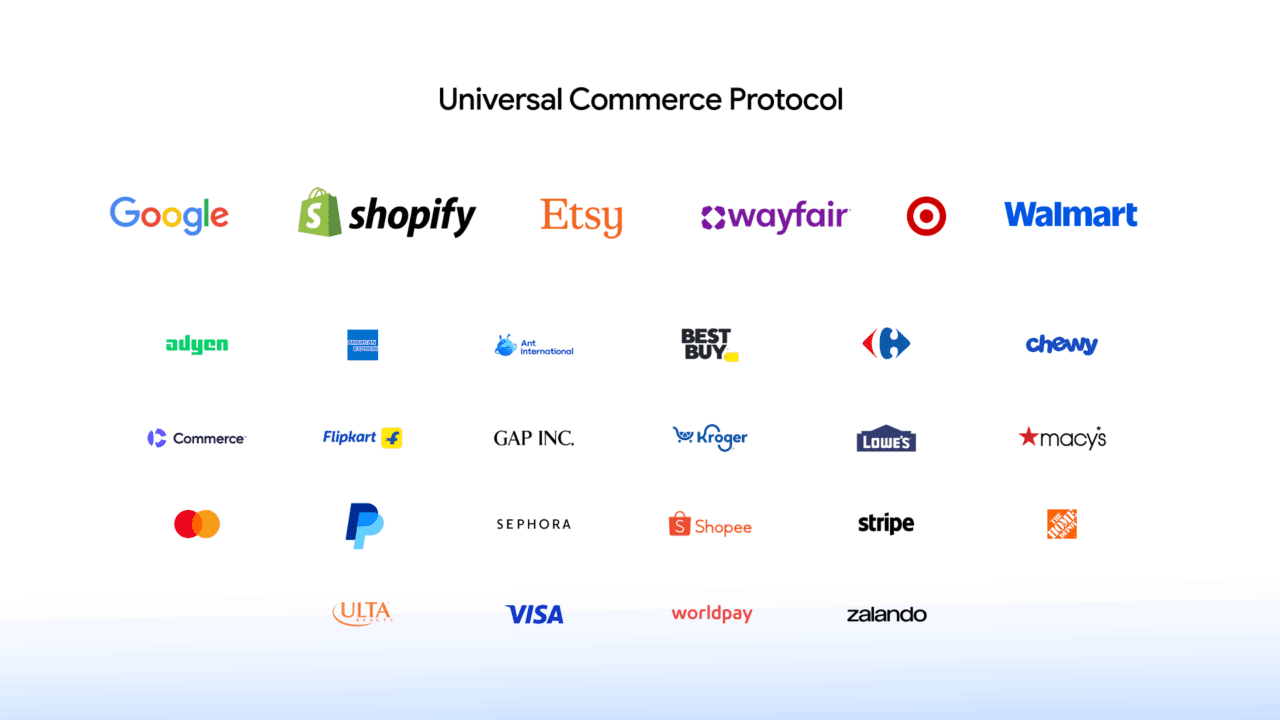
In addition to Shopify and Etsy, other partners in the development of UCP include Wayfair, Target and Walmart, and the protocol is endorsed by more than 20 others across the ecosystem, including Adyen, American Express, Best Buy, Flipkart, Macy’s Inc., Mastercard, Stripe, The Home Depot, Visa and Zalando.
“At Wayfair, we’re focused on building commerce experiences that work seamlessly for customers, however they choose to shop,” said Fiona Tan, Chief Technology Officer at Wayfair in a statement. “The Universal Commerce Protocol establishes an open, agent-ready foundation for the future of commerce, and we’re proud to partner with Google and other industry leaders to help shape it.”
Direct Checkout Arrives in Google
As a first test of UCP, shoppers using AI Mode in Google Search and on the Gemini app will soon be able to checkout from eligible U.S. retailers directly in those platforms using Google Pay, with payment via PayPal arriving a short time thereafter. Retailers remain the seller of record, with the ability to customize the integration to their specific needs.
Google will continue to add additional capabilities to the experience in the coming months, said Srinivasan, including expanding globally and adding features like discovering related products, applying loyalty rewards and powering custom shopping experiences on Google.
The arrival of checkout in Google is not a surprise. Competition notwithstanding, first hints of the capability were seen in mid-2025 when the company launched the ability for users to empower Google to purchase a product directly in its price tracking tool when the price fell within their desired range.
In fact, AI has somewhat upended Google’s stance on its role within the world of shopping. Until recently, executives have avidly maintained that Google’s role was as the starting point not the end point of shopping journeys, with one former executive telling Retail TouchPoints back in 2021 that the company was “indifferent on where the shopping journey ends, where that transaction takes place.” But the entrance of generative AI into the realm of search has flipped everything on its head — indifference is clearly no longer an option.
One More Thing — Discounts in the Moment
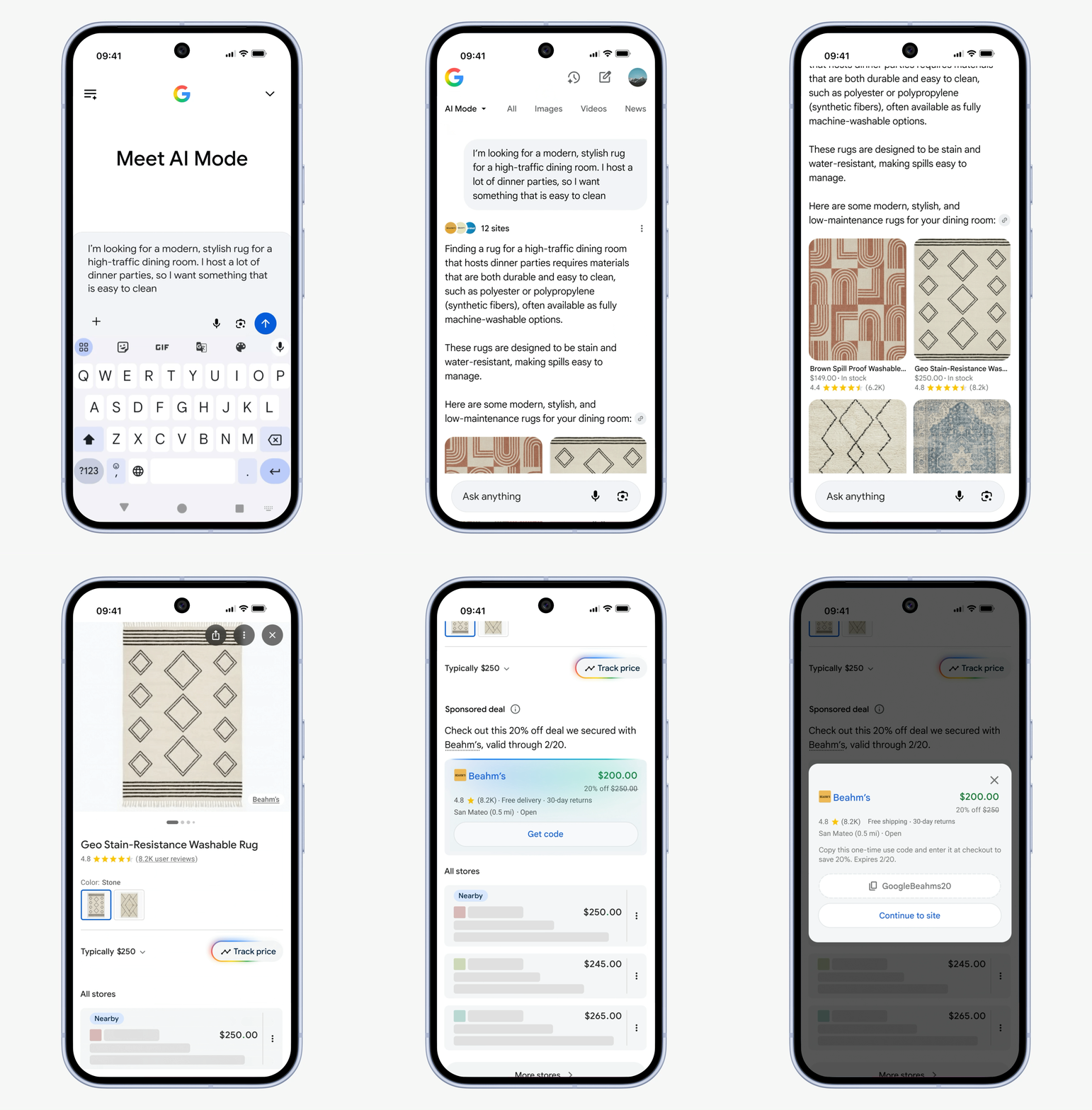
In other interesting news, a new pilot in AI Mode from Google Ads, called Direct Offers, will allow advertisers to present exclusive offers for shoppers who are ready to buy — like a special 20% off discount.
For example, a user may start off an AI Mode search with a query like: “I’m looking for a modern, stylish rug for a high-traffic dining room. I host a lot of dinner parties, so I want something that is easy to clean.” As it always does, Google will pull a range of products that meet the criteria. Now, select retailers whose products appear will have the opportunity to nudge a purchase along by featuring an additional discount.
“That’s a real win, both for shoppers as well as the retailer, because the shoppers get real value and the retailers have a new way to offer custom deals to specific shoppers who are ready to buy, without having to extend the same thing to everybody,” explained Srinivasan. “This moves beyond traditional ads.”
Among the brands partnering with Google to develop the Direct Offers feature are Petco, E.l.f. Cosmetics, Samsonite, Rugs USA and Shopify merchants. Retailers will set up relevant offers they want to feature in their campaign settings and Google will use AI to determine when an offer is relevant to display. Initially the feature is focused on discounts, but it will eventually expand to support the creation of offers with other attributes that help shoppers prioritize value over price alone, such as bundles and free shipping.