

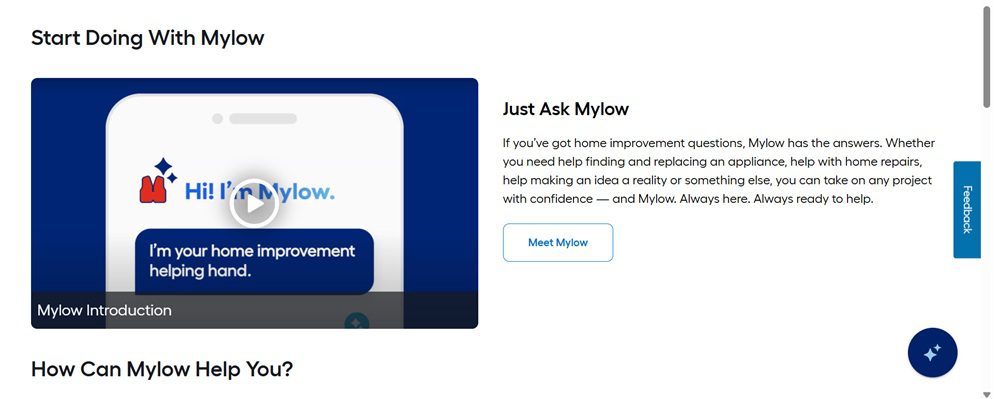
Lowe’s knows that home improvement projects can be daunting. Even a relatively modest bathroom or kitchen renovation involves money, time, inconvenience and choices — so many choices. To help these customers move past their initial fear and get started, Lowe’s launched the AI-powered Mylow app in March 2025, which now offers enhanced visualization tools; targeted content, including videos and articles; and in-app purchasing capabilities.
These and other AI-powered initiatives have helped Lowe’s achieve a 2X conversion rate for Mylow users compared to non-users. “We want to focus on that high-intent customer and capture as much of that [purchase] as we possibly can,” said Joe Cano, SVP, Digital Commerce at Lowe’s in an interview with Retail TouchPoints where Cano also shared the many ways AI is changing the customer and associate experiences at Lowe’s.
Retail TouchPoints: How do you see the Mylow app helping customers who are apprehensive about starting a big home improvement project?
Joe Cano: Customers [using Mylow] aren’t asking it, “What’s the best refrigerator?”, they’re asking “How do I do this project?” That means they’re a higher-spend customer and we need to help them more. To find a refrigerator you can go into a store and do a lot of research, but renovating a kitchen — I don’t know that there’s any step-by-step of how, exactly, to renovate your kitchen and the best way to do it. That’s where we’re really focused, on solving those problems.

With Mylow, you can take a picture of your bathroom and upload it to the app, and then you can choose different tiles for the floors and the backsplash, a new mirror, a new vanity, a new toilet — you can fully customize your bathroom. We’ll put it all into a portfolio for you that you can bring into the store and say to our designers, “Hey, this is what I was thinking; do you like this? Do you have it in stock, and if not how can I get it? Do you have a pro that you can connect me to?”
Customers also can use Mylow for inspiration, for example with kitchens — obviously, another huge undertaking. You can say to Mylow, “I want a modern kitchen with lighter wood cabinets and stone countertops, and here’s a backsplash that I might want.” Then we use Google’s Nano Banana [AI image generation] technology to showcase great images and help them start creating their kitchen of the future. And of course, people also can use Mylow to make purchases.
RTP: AI has been growing rapidly, but traditional Google search is likely still the predominant way customers interact with Lowe’s. How are you serving those consumers?
Cano: We just announced [during the NRF Big Show] a great partnership with Google. If you’re on Google and type in Lowe’s, that allows you to ask questions of both Mylow and Google — and [in responding], it uses the tone of voice that Lowe’s would. It’s a great way for us to say, “OK, I want to meet you where you’re at.” We know that not everybody’s going to come to Lowes.com.
RTP: Are there other ways Lowe’s is enhancing and personalizing the shopping experience?
Cano: We’ve noticed that our younger customers, millennials and Gen Z, just don’t want to see a still picture anymore; they want to see video content. So, we’ve relaunched our creator network, which includes about 2,000 creators, including the well-known Mr. Beast. We’re showcasing our amazing products via our creator network.
We’re also able to customize the videos that you see on Lowes.com to you and your search. We worked with Firework so that if, for example, you’re searching for a new drill, we’ll point out the drills that everyone’s focused on, and you can watch 15-second videos to see which is the best one for you.
What this means is that the content on your homepage is going to change, so that what you see on Lowes.com versus what I see is going to be different — depending on if you’re a known person and we know your search history. We’ll say, “Here are the deals we have on drills right now, here’s some at a high price point, here’s some at a low price point.”
That’s why people are using AI agents, because it gets them to an answer in a quicker manner. This is a way for us to say, OK, you’re asking me a question; I’m going to give you stuff so that you don’t have to search through pages and pages of product. We’re going to serve you everything that we think you want as well. All that combined is showcasing how we’re bringing in content within product and curating it for you so that you’re not scrolling through endless aisles, because nobody has time for that anymore.
RTP: How does Lowe’s know what type of content will be most relevant?
Cano: If you’re on Mylow and get a null search term [a query with zero results], it means we actually don’t have an answer for you. Then, that triggers us to say that if a lot of customers are actually asking about this, [we should create content about it]. Then we go into our creative studio in Charlotte, N.C., which is also owned by my team. So if everyone’s asking, for example, “How do I paint my cabinets?”, we’re showing them: here’s the primer; here’s how long it takes. We’re looking at all these new ways customers are interacting with us.
RTP: What else has Lowe’s learned from customers?
Cano: Customers have let us know their intent in faster ways. For example, originally we weren’t going to integrate voice [interactions with Mylow] until later this year, but we saw that customers were really interacting with voice-enabled OpenAI and ChatGPT and other agents, so we actually pulled that forward. It just launched, and people are engaging with it.
And we saw that it wasn’t just our customers; associates in our stores wanted [voice] access to the technology as well, so instead of typing on their handheld device, they’re saying “Where can I find X, Y and Z?” That’s saving so much time for our associates and making it easier for them to actually help customers in stores. That’s been a huge win for us.
Most of our customers don’t come into the store knowing what they need; they just know that they have a problem and they need you to help fix it, so getting our associates armed with that information has been so important. Home improvement is a great space for AI applications because, unlike an apparel purchase, it’s complex, and AI is going to be the way we can help with those complex purchases.