

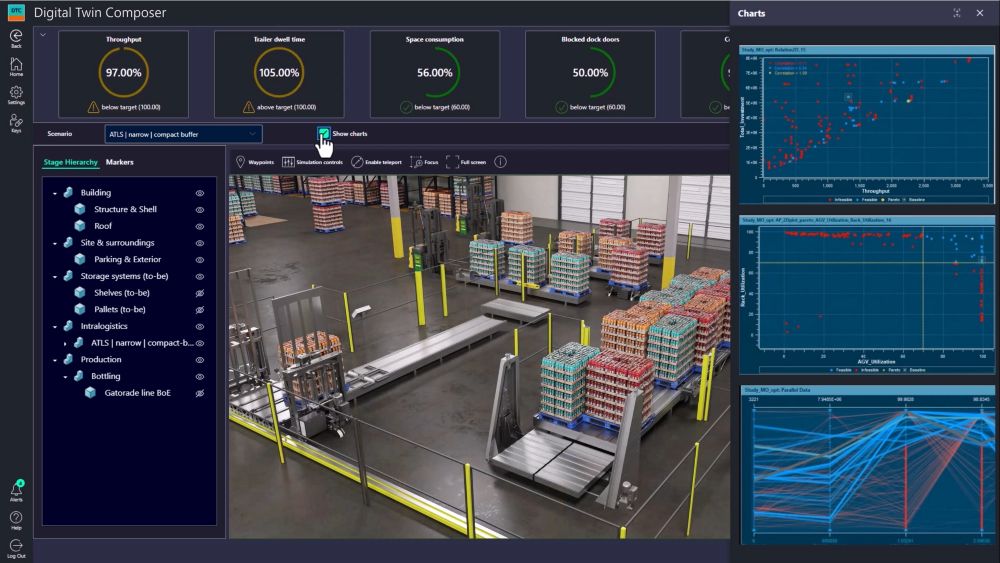
PepsiCo is using AI agents and physics-based digital twins as “co-designers” to simulate, validate and optimize manufacturing and supply chain facility layouts before any physical building takes place. It’s part of a multi-year collaboration among the food and beverage giant, Nvidia and Siemens to shift to a digital-first planning strategy as PepsiCo deals with rising demand for production and distribution capacity.
Using the Nvidia Omniverse libraries, PepsiCo and Siemens are digitally transforming select U.S. manufacturing and warehouse facilities, converting them into high-fidelity 3D digital twins that simulate plant operations and the company’s end-to-end supply chain. Using the Siemens Digital Twin Composer, PepsiCo can now re-create every machine, conveyor, pallet route and operator path with physics-level accuracy, enabling AI agents to simulate, test and refine system changes — a process that can identify up to 90% of potential issues before any physical modifications take place.
On initial deployment, the new approach already has delivered a 20% increase in throughput and is driving faster design cycles, nearly 100% design validation and 10% to 15% reductions in capital expenditures by uncovering hidden capacity and validating investments in a virtual environment. PepsiCo is planning to simulate upgrades to other U.S. facilities, with plans to scale the technology globally.
“The scale and complexity of PepsiCo’s business, from farm to shelf, is massive — and we are embedding AI throughout our operations to better meet the increasing demands of our consumers and customers,” said Ramon Laguarta, Chairman and CEO of PepsiCo in a statement.

Digital Twin Usage on the Rise in Retail
This collaboration represents one of the first uses of digital twin technology in manufacturing and fulfillment, but retailers have begun making use of the technology as well. In February 2022, fitness franchise Orangetheory created photorealistic 3D digital twins of its U.S. studios to help ensure design consistency across all 1,250 locations.
Lowe’s revealed in March 2025 that the home improvement retailer uses AI-generated 3D digital twins of its stores to optimize layouts and merchandising. The system provides a video game-style interface that allows decision-makers to virtually move products, fixtures and displays, helping them determine optimal product placements and deal with other store-level issues.
“Physical industries are entering the age of AI,” said Jensen Huang, Founder and CEO of Nvidia in a statement. “For companies with real-world assets, digital twins are the foundation of their AI journey. PepsiCo is re-architecting its operations — using physically accurate digital twins and AI to reinvent how it designs, optimizes and runs its global operations.”