This article first appeared in our sister publication Shop Eat Surf Outdoor
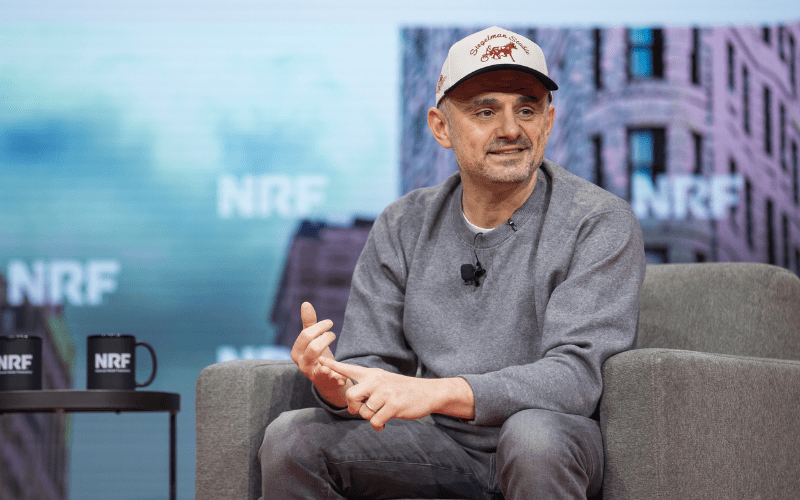
Earlier this year at the NRF Big Show, VaynerMedia CEO Gary Vaynerchuk — a best-selling author, early investor in companies like Facebook, Twitter, Tumblr, Venmo, Snapchat and Uber, and social media star with over 50 million followers across multiple platforms — stood before the packed room of retail professionals and asked a simple question: “How many people in this room are aware of what Whatnot is?”
When asked to stand, barely 3% of the audience rose. The punchline? Whatnot, a live-streaming shopping app, generated between $7 billion and $10 billion in gross merchandise value last year.
This disconnect illustrates Vaynerchuk’s central thesis: huge opportunities exist right now, but many businesses are too slow to see them. Whether it’s the explosion of live shopping or the democratization of viral content, the landscape of attention is shifting rapidly.
Here is how Vaynerchuk suggests brands and creators navigate this new era of digital revolution.
Stop Acting Like Don Draper
For decades, advertising relied on a Mad Men-style model. Executives would sit in a room, debate the subjective quality of a creative asset and then spend millions of dollars to force people to see it.
Vaynerchuk argues that this era is over.
“The smartest marketers are obsessed with context, volume, relevance at all cost, humility around creative, not leaning on your subjective opinion like you’re Don Draper in 1965, but understanding that we are in a distribution model now where we can create creative at scale and get consumer insights and data affirmation that then allow us to deploy paid media,” he told the audience at NRF.
“For another framework on this, friends, I think we’ve lived in advertising for 70 to 80 years in a model that used working media dollars to hide bad creative,” Vaynerchuk added. “I think we’re now clearly in the era of let’s use working media dollars only to amplify and scale good creative, and good is judged by did it actually achieve views, not four executives in a room saying, ‘That’s on brand.’”
The Live Shopping Revolution is Coming
While the U.S. market has been slower to adopt live social shopping compared to China, Vaynerchuk believes it is inevitable. He points to the success of apps like Whatnot and the massive scale of TikTok Shop as proof that the tide is turning.
“I think this is social media all over again,” he said. “A bunch of people in this room and a bunch of people in this industry 10 years ago said, ‘Social’s not for us. We’re a high-end brand. We’re expensive. We have a higher AOV (average order value).’ This is all I heard in 2010, ’17, ’13, ’12. Everything sells on social now, and everybody knows that.”
Every brand now needs to also devise a live shopping strategy as well, Vaynerchuk said.
“Live shopping is not built for (tchotchkes) like Labubus,” he said. “In China, they sell cars at scale through live shopping. Live shopping is attention. Consumers see something, and they act on it. It’s a frictionless environment. You’re in your feed. It just shows up. You like purses. You buy a purse. It’s easier than any other ecommerce.”
He warned that companies need to get on board quickly or risk getting left behind: “Anyone here at a Fortune 5,000 level that isn’t spending an enormous amount of time trying to figure out their live shopping strategy and figuring out their GEO and AEO strategy — if they’re not doing that, they are setting themselves up for very challenging 2027, 2028 realities,” Vaynerchuk said.
The Impact of AI on the Creator Economy
Artificial intelligence is undoubtedly shaking up the creative world, specifically the influencer economy. Vaynerchuk acknowledges that AI-generated influencers will likely take market share from lower-tier human influencers. However, he remains optimistic about the human spirit and its ability to navigate big changes.
“Nobody felt bad for the A-list celebrities that the influencers have come along and taken money out of their pockets,” he said. “And so I don’t feel bad (about) the people that create AI influencers and bring value to the consumer. And if they start getting brand deals and they come out of the [human] influencers’ [piece of the business], I think this is an evolution. I think this is just what happens. Many inventions through the history of time are demonized up front, electricity being my favorite historical story of how we tried to not accept it. We were big on candles back in the day.
“So, am I concerned? I’m not concerned in the macro,” he added. “I believe in the human spirit. We’ve navigated atomic bomb invention. I think we’ll navigate the AI invention. But do I think a lot of B, C, D- list influencers… do I think that they have a vulnerability on losing brand deals to AI influencers? I know they will.
“But I would also argue, when I look at this crowd, I get so happy knowing that so many people’s parents, children, spouses and [they] themselves will live 10 to 15 years longer because AI in medicine will detect a disease earlier than [before]. There’s so much remarkable joy that’s coming [with AI], I think some business commerce reshaping is frivolous in comparison to the upside.”
It Is Easier to Break out Today Than Ever Before
A common complaint among new creators is that platforms like YouTube are “too mature” and that it’s too late to get started. Vaynerchuk completely rejects this idea. While early adopters who bought “beachfront property” on YouTube in the early days certainly had an advantage, the algorithms have changed in a way that favors newcomers.
In the past, you had to spend three or four years building a following before anyone saw your content. Today, interest-based algorithms on platforms like TikTok, Instagram Reels and YouTube Shorts allow you to go viral on Day One, he said.
“Somebody here can literally make their first TikTok ever and it could be the start of the whole game,” Vaynerchuk said. “The level of merit and opportunity for the individual human because of where the algos are in social right now and for every business is profound, profound, and I want more people to take advantage of it.”