

This article first appeared in our sister publication Shop Eat Surf Outdoor
Following years of fluctuating consumer confidence and flat ecommerce traffic, retailers braced for a modest performance in holiday 2025. Yet the data tells a different story: a record-breaking season defined by a massive surge in online activity and the emergence of a new, highly effective sales driver.
According to Salesforce’s post-holiday analysis — drawing on data from over 1.5 billion global consumers — global online spending hit $1.3 trillion between Nov. 1 and Dec. 31, 2025 marking a 7% bump year-over-year. While North America saw a healthy 5% increase, Europe emerged as the surprising bright spot, delivering 12% year-over-year growth.
However, the headline isn’t just the revenue volume — it is the new technology helping to power it. AI influenced $262 billion of that global online spend, said Salesforce Director of Consumer Insights Caila Schwartz and Gordon Evans, CMO of Agentforce Commerce, during a presentation at the NRF Big Show earlier this month.

“It’s guided shopping, agentic agents, shopper agents, agentic customer service, AI-fueled product recommendations and agentic search,” Schwartz said.
Agentic AI is an advanced form of artificial intelligence focused on autonomous reasoning, decision-making and action. Agentic AI systems can set goals, plan and sometimes even execute tasks with minimal human intervention.
Traffic and Conversion Rates Jump
For the past several years, ecommerce traffic has slowed, so going into the 2025 holiday season, industry forecasts predicted those levels to remain flat. “We were not anticipating any movement in traffic,” Schwartz said. “We just kind of assumed we’d hit peak traffic.”
This assumption proved incorrect.
Toward the end of the holiday season, traffic surged by over 20% across all regions. “What we believe drove that were these new channels, particularly AI-powered search,” she said.
The most significant finding wasn’t the volume of traffic referring to retail sites from these AI channels — though that did see triple-digit growth — but the quality of that traffic.
Data indicates that visitors referred by AI search engines:
- Converted at a rate 9X higher than traffic coming from social media channels; and
- These users were significantly more engaged, spending 38% more time on site than the average visitor and 137% more time than users from social media referrals.
Schwartz said this signals the rise of a “highly motivated buyer.” Unlike a user passively scrolling through Instagram who might click an ad on impulse, a user engaging with an LLM (large-language model like ChatGPT or Google Gemini) is asking deep, specific questions. By the time they click through to a retailer’s site, they have already performed their due diligence.
They are not browsing; they are ready to transact, “so even though they’re getting a lot of information through these conversations, these chats, they’re still staying engaged with the brand when they come on site, which is really important,” Schwartz said.
The Evolution of Brand-Owned Agents — Meet “Olive” at Williams Sonoma
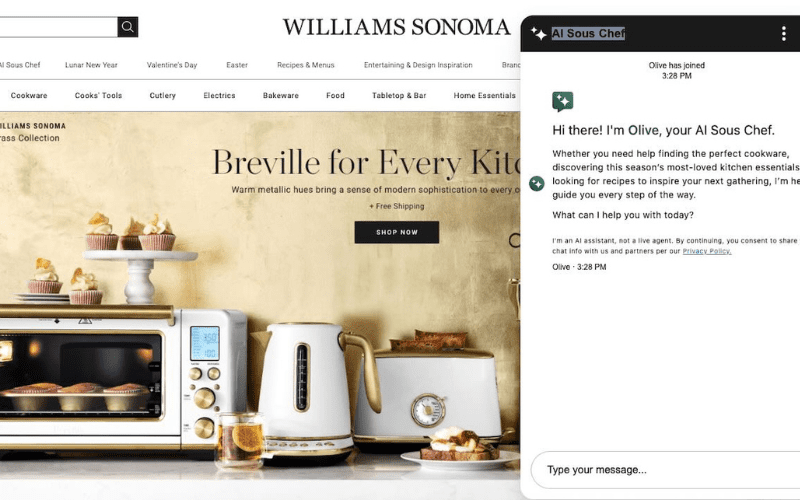
While third-party AI search drove traffic, brand-owned agents — AI interfaces hosted directly on retail sites — helped close the sale in many cases.
A prime example cited by Salesforce was “Olive,” the AI agent for Williams Sonoma. Far from a simple customer service bot, Olive functions as a “sous chef,” assisting customers with meal planning, Thanksgiving preparation, and even dietary restrictions like gluten-free options. This new class of agent acts more like a knowledgeable store associate than the customer service chatbot of old.
Overall, approximately 20% of retailers launched their own shopper agents prior to the holiday rush, using the season as a “pressure cooker” to test new innovations, Schwartz said.
The gamble paid off. Brands that deployed shopper agents (6.2%) saw 59% higher sales growth compared to those that did not (3.9%), according to Salesforce data.
“We’ll see what happens in 2026, but this data is very encouraging,” Schwartz said.
Customer Service Morphs into a Sales Driver
Historically, customer service has been viewed as a cost center, particularly during the high-volume holiday period. However, the 2025 season demonstrated that agentic AI service is becoming a critical part of the customer journey and a driver of loyalty, according to the Salesforce data.
Between November and December, there was a 66% increase in the rate of agentic conversations compared to the prior two months. Also notable, the rate of autonomous actions taken by these agents increased by 142%.
These agents were not merely routing tickets to humans; they were solving problems independently. From processing returns to updating shipping information, AI agents handled complex workflows without human intervention.
This speed has a direct impact on brand perception. Pandora, the jewelry retailer, utilized agents to interact with shoppers in a way that mimicked their high-touch in-store experience. The result was a 60% improvement in case deflection (enabling customers to self-solve issues rather than having to call customer service) and a 10% increase in Net Promoter Score (NPS), according to Salesforce. By resolving issues instantly and accurately, autonomous agents are turning potentially negative service interactions into positive brand experiences.
The 2026 Roadmap: Transforming the Shopper Experience
If 2025 was the year of “agentic efficiency,” 2026 will be the year of “transforming the shopper experience,” Schwartz said. The roadmap for the coming year suggests that AI will move out of the bottom-right corner of the screen and become integrated into the fabric of the ecommerce interface.
The Next Generation of Agents
Future agents will possess context across multiple datasets, Salesforce said. Currently, an agent might know a customer’s shipping status but not their style preferences. The next generation of agents will unify customer service history, order history, real-time inventory and stylist availability.
This means a customer could ask, “Where is my order?” and follow up immediately with, “I need to book a styling appointment,” without the agent losing the thread of the conversation.
Breaking the “Chat Bubble” Paradigm
Retailers are beginning to experiment with placing agents in specific high-friction areas of the website.
- Site search: An agent embedded in the search bar could ask clarifying questions about color or occasion after a user types “winter formal dress”;
- The cart: Agents could proactively offer shipping alternatives or cross-sell items based on delivery timelines; and
- Product detail pages (PDP): An agent could intervene to prevent returns by analyzing a customer’s purchase history and advising, “Based on your past purchases, this size might not fit you. We recommend sizing up.”
Looking Ahead
The Salesforce team was encouraged by the positive impact of new AI technology on both traffic and conversion during the holiday season, “and the reason why we find it encouraging is because the trends that we see take place and take shape during this period typically set the tone for the next year,” Schwartz said. “And we are seeing that these technologies are having a significant impact on growth and performance.”