

The New Reality of Retail Self-Service
Self-service is no longer confined to a few large touchscreens near the front of a store. Today, it shows up everywhere, often in places shoppers do not consciously label as kiosks at all.
It might be a self-checkout lane at a grocery store. A tablet used to order food at a warehouse club. A locker system where online orders or returns are picked up without speaking to an associate. A photo-printing station at a pharmacy. A hotel check-in screen that replaces a long front-desk line. Even a small payment device handed to you at the counter is, functionally, a self-service system.
What all of these experiences have in common is that shoppers are expected to complete a task independently, often under time pressure, without the ability to use their own assistive technology.
Retailers have embraced self-service for clear reasons. These systems help address staffing challenges, reduce wait times, support late-night or high-volume operations and enable inventory management, fraud prevention and upselling through newer camera- and AI-enabled technologies. Consumers, for their part, have grown comfortable handling transactions on their own and increasingly expect that option.

But as self-service becomes mission-critical, its shortcomings are becoming harder to ignore.
One Interface Doesn’t Fit All Shoppers
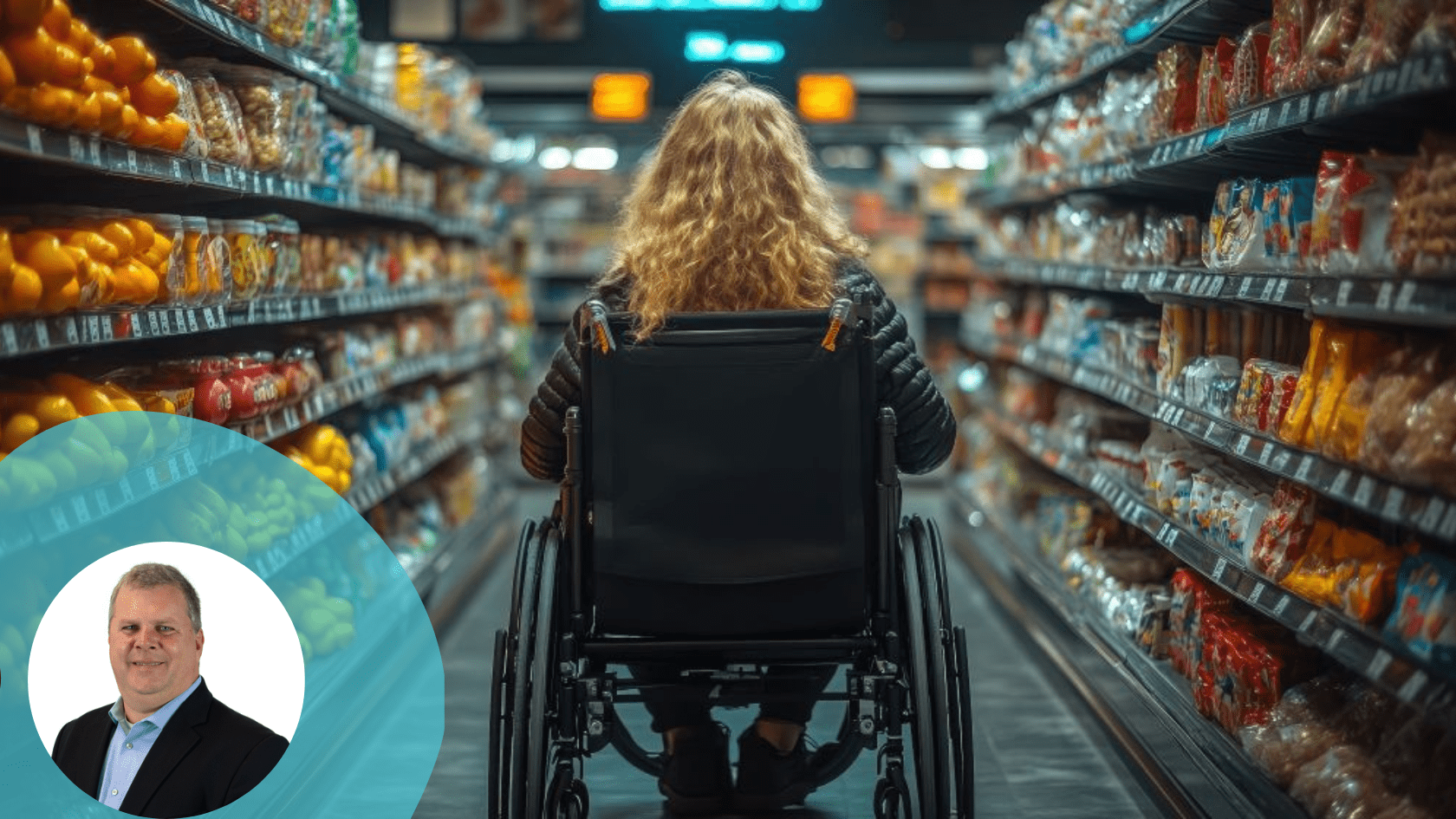
Many self-service systems are still designed around an assumed default shopper, someone who can see the screen clearly, hear prompts in a noisy store, navigate touch interfaces precisely and stand comfortably throughout the interaction.
That assumption breaks down quickly in real retail environments.
Consider a grocery self-checkout that silently scans items but never confirms what was scanned or the running total. For a blind shopper, there is no way to know whether an item was scanned twice, whether the price is correct or whether a mistake occurred. Selecting produce from an on-screen menu after placing items on a scale may be simple visually, but it is impossible without audio guidance.
These gaps do not only affect people with permanent disabilities. Bright lighting glare, loud ambient noise, crowded layouts, language barriers, temporary injuries, or even holding a child can make seemingly simple interactions difficult. Far more shoppers are excluded by single-mode design than retailers often realize.
Defining Multimodal Self-Service
Multimodal self-service acknowledges that no single interface works for everyone, all the time.
Instead of relying solely on touch and visuals, multimodal systems offer multiple ways to interact, including audio output through headphones, tactile input, spoken guidance and increasingly adaptive interfaces. The goal is not complexity. It is choice.
Choice enables independence. A shopper should be able to complete the same task, whether ordering food, paying securely or retrieving a package, regardless of how they interact with the system.
This approach moves accessibility out of a hidden mode and into the core experience. When inclusion is designed in from the start, accessibility becomes part of how the system works, not an exception to it.
Accessibility as a Business Imperative (Not Just Compliance)
In the United States, accessibility requirements for retail technology have historically focused more on physical access than digital interaction. In contrast, regulations in Europe now explicitly cover retail, transportation, banking and other public services, and require new systems to be accessible by default.
But the strongest case for accessibility is not regulatory. It is experiential.
When customers encounter inaccessible systems, they struggle and they leave. Often they do not return. When self-service works independently and privately, especially for something as personal as payment, it builds trust.
Being able to hear what you are paying, choose a tip or enter a PIN without announcing it to someone else is not a luxury. It is dignity.
The Operational Upside of Inclusive Kiosks
Inaccessible self-service has operational costs that retailers often overlook.
When kiosks do not work for everyone, staff are pulled away from other responsibilities to intervene. Lines slow down. Transactions are abandoned. Frustration builds, sometimes loudly and in full view of other customers.
Inclusive, multimodal kiosks reduce these friction points. They allow more shoppers to complete tasks independently, keeping traffic moving and enabling staff to focus on areas where human interaction truly adds value.
In high-volume environments such as grocery, quick-service restaurants and travel retail, even small improvements in completion rates and throughput can have significant impact.
Technology is Catching Up, if Retailers Use it Thoughtfully
Technology has advanced rapidly in recent years. Payment devices increasingly support private audio interaction. Self-checkout systems now use cameras and AI to reduce errors and fraud. Software platforms are more capable of supporting adaptive interfaces.
But technology alone does not guarantee usability.
Accessibility fails when it is treated as a checkbox. A keypad without audio support or a headphone jack that does nothing creates the appearance of inclusion without actually delivering it. Effective self-service requires accessibility to work end to end, not just exist in hardware.
Designing for Real-World Retail Environments
Retail does not happen in a lab. It happens in noisy stores, crowded aisles, harsh lighting and moments when shoppers are rushed.
Airports provide a clear example. While accessibility is legally required for airline kiosks, real-world execution varies widely. Some systems provide functional audio guidance. Others include the physical components but fail to activate them. For customers, the difference is simple. The experience either works or it does not.
Designing for reality requires testing with diverse users, in real environments, and accepting that edge cases are often common cases.
Inclusion as a Competitive Differentiator
As retail competition increasingly centers on experience rather than price, inclusive self-service is becoming a meaningful differentiator.
Small decisions can have outsized effects. Quiet shopping hours for customers with sensory sensitivities, clearer and more flexible interfaces and systems that respect privacy and independence are choices that communicate who a brand is for and who it values.
The Path Forward for Retail Leaders
The next phase of self-service is not about adding more screens. It is about designing better ones.
Retail leaders should treat kiosks and self-directed systems as core customer experience platforms. That means acknowledging user diversity, embedding accessibility early and designing for long-term scale.
Five years from now, success will look like self-service that fades into the background because it works for everyone.
Meeting Every Shopper Where They Are
Self-service is now one of the most visible expressions of a retail brand. When it excludes, customers notice. When it empowers, they remember.
Multimodal, accessible self-service is not optional. It is essential to the future of retail customer experience.
Matt Ater is SVP at Vispero and a recognized leader in accessibility, assistive technology and self-service innovation. He was named to the 2025 Forbes Accessibility 100, serves on the Consumer Technology Association Board of Industry Leaders and is a member of the Kiosk Hall of Fame. A frequent keynote speaker and subject matter expert, Ater brings decades of experience across accessibility, consumer electronics, and business development.