
Key Takeaways
- More than half of Americans plan to shop on Small Business Saturday in 2026, but consumers are prioritizing clear value, convenience and fast service as holiday budgets remain under pressure.
- AI is becoming a bigger part of the holiday shopping journey, influencing gift discovery, price comparison and retailer selection even as most shoppers stop short of letting AI complete purchases for them.
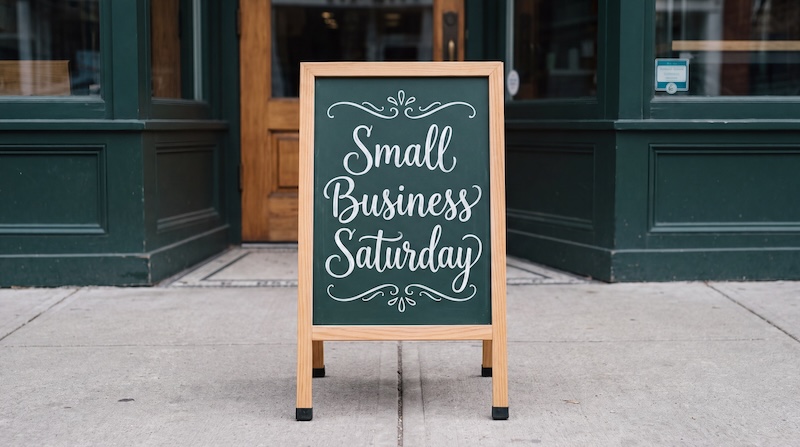
More than half of Americans plan to shop on Small Business Saturday this year, according to the third annual AT&T Business Holiday Shopping Survey, a signal that local retail still has a seat at the table during the most competitive shopping stretch of the year.
The AT&T research, along with those from Salesforce, KPMG, Walmart and Southpaw Insights, makes clear that shoppers in 2026 are spending more carefully. Budgets are tighter, expectations are higher and AI is now part of how consumers find deals and choose where to buy.
Small Business Saturday, falling on Nov. 28 this year, interest remains strong, according to the third annual AT&T survey as 52% of Americans plan to shop: 34% in person and 24% online.
Local Appeal, Big-Retailer Expectations on SBS
Shoppers want what small businesses already offer, including personal service and community ties. But they also expect the speed and convenience of larger retailers. Seven in ten expect a same-day response to a message or inquiry, including 20% who expect a reply within an hour. Text (40%), email (39%) and phone calls (38%) are the channels shoppers find most helpful.
“Shoppers want the warmth of a neighborhood shop with the ease of a big retailer, and small businesses shouldn’t have to choose between them,” said Matt Cook, senior vice president of Mid-Markets Sales at AT&T Business, in a statement.
Consumer Confidence Is Unsteady Heading Into the Holiday Season
Small businesses face those expectations in a holiday season that’s hard to forecast. Nikki Baird, vice president of strategy and product at Aptos, said that early forecasts were bullish, but consumer confidence has slipped since then. Shoppers are carrying heavier debt loads, and much of the spending growth in recent years has come from upper-income households whose wealth is tied to the stock market.
“I feel like I say this every year, that it’s really uncertain,” Baird told ReatilTouchPoints.com. “But this year is uncertain in different ways than it’s been uncertain in the past.”
Online shopping with small businesses is gaining ground. AT&T Business found preference for shopping online with small businesses rose five percent from the year before to 37%, while preference for large retailers fell the same percentage points to 63%.
How shoppers find small businesses depends on their age. Gen Z shoppers are nearly twice as likely to discover small businesses through social media as through word of mouth (37% vs. 19%). Boomers are more than three times as likely to rely on word of mouth as social media (30% vs. 9%). That points to two different outreach strategies: social content for younger customers and memorable in-store experiences that get older customers talking.
Consumers Plan to Spend, but Value Comes First
Holiday budgets are rising. KPMG’s Consumer Pulse Holiday 2026 survey found average holiday shopping spend will increase 5% to $783 as 45% of consumers expect to spend more, while 26% expect to spend less.
Salesforce reports a similar trend online. U.S. online sales from Oct. 1 through Nov. 15 rose 5% year over year and 5.5% globally. The company predicts Cyber Week, which runs Nov. 24 through Nov. 30, will produce a record $357 billion in global online sales and $84 billion in the U.S., each up 6%.
Retailers are responding with discounts. Salesforce found November discount rates are up 8% in the U.S. and 5% globally. As a result, average selling prices for physical goods are down 1% in the U.S. and 2% globally. Basket sizes are up 3%. “We’re expecting a blockbuster Cyber Week despite economic headwinds,” said Caila Schwartz, head of Agentic Commerce Shopper Insights at Salesforce.
Shopping Starts Earlier, but Last-Minute Demand Remains
More shoppers are planning ahead. Walmart’s Holiday Trend Report found 28% of shoppers expect to start earlier than last year, mainly to avoid a last-minute scramble and spread out spending. About two-thirds of Walmart gift purchases are planned ahead of time.
The Arkansas-based retailer’s survey found 38% of shoppers expect to do most of their holiday buying between October and the first half of November. Another 20% expect to do most of it between Thanksgiving weekend and Cyber Monday.
That does not mean panning doesn’t eliminate late demand as 34% of Walmart respondents stated gift purchases still happen in the moment, and half of its shoppers were still buying a week before Christmas last year. And AT&T Business found 45% of Americans would choose a nearby small business for a last-minute gift, compared with 32% who would choose a nearby large retailer.
AI Moves Into the Mainstream Shopping Journey
AI appears in all four retail-focused reports as a research and comparison tool. Baird cautioned traffic from AI sources still accounts for less than 5% of retailer site visits. That number misses how often AI shapes gift ideas and points shoppers toward a store before they ever click through.
“AI influence is definitely much broader than just AI traffic,” Baird said. “Would you have gone to this retailer if AI hadn’t said, ‘Hey, you should think about XYZ gift for this niece you’ve seen three times in the last three years’?”
Salesforce, who reported nearly 70% of shoppers are waiting for Cyber Week to make big purchases, predicts AI and shopping agents will influence $75.8 billion, or 21%, of global Cyber Week sales, up from $67 billion in 2025. AI-driven traffic to retailer websites is up 104% year over year. Shoppers who arrive through AI referrals are twice as likely to convert as other ecommerce shoppers.
Walmart reported that 53% of its surveyed customers say AI makes everyday tasks easier, and 39% say it helps them make better decisions. KPMG found consumers plan to use AI to:
- Compare prices across retailers: 37%
- Find discounts or promotions: 33%
- Compare product reviews: 33%
- Research gift ideas: 29%
While Salesforce found 74% of consumers trust AI recommendations, 73% aren’t ready to give a personal agent their credit card details. AT&T Business found 59% of adults wouldn’t let an AI assistant research and buy gifts for them, while 21% would use it for research only and 20% would use it for both.
AI Is Shaping How Consumers Research Gifts and Compare Retailers
AI influences which brands shoppers find. According to Salesforce, one in three shoppers discover new brands through AI assistants, and 11% say they won’t buy a product if AI advises against it. Brands that run their own shopper agents report gains: shoppers who use them spend 8% more per order and buy 23% more items.
That shift could work in favor of independent retailers. Baird said small businesses have fewer legacy systems and processes to work through than large chains. She added that platforms such as Shopify are surfacing smaller sellers in AI recommendations, which exposes shoppers to retailers they wouldn’t have found before.
“We see smaller businesses adopting a lot faster because it’s easier due to their size,” Baird said. “They can do things that were outside of their reach before or were really expensive and now are cheap.”
Omnichannel Convenience Is a Baseline Expectation
Shoppers move between digital and physical channels, and they expect both to work. In-store shopping remains the top holiday destination. Salesforce found 71% of shoppers plan to shop in store, including 63% of Gen Z. One in three Gen Z shoppers plans to visit a store for an early-morning Black Friday promotion.
The trip often starts online. AT&T Business found that before visiting a small business, 53% of consumers check its location, 47% check hours, 41% read reviews and 30% check inventory. Shoppers expect tools that once set large retailers apart. According to AT&T Business:
- 43% expect online ordering.
- 40% expect buy online, pick up in store.
- 38% expect digital payments.
- 38% expect text or email order updates.
Social media importance as a sales channel continues to grow as Salesforce found 23% of ecommerce traffic comes from social media clicks, up 13% year over year, led by TikTok and Instagram. Orders from social referrals grew 27% across October and November, and more than one in four shoppers bought something inside a social app in the past three months.
Payment preferences remain traditional. KPMG found cash (83%) and credit cards (80%) are the top choices, with buy now, pay later use rising.
Shoppers Are Cutting Carefully, Not Cutting Everything
At the forefront of all of this is consumers balancing higher spending with financial stress. Southpaw Insights’ American STRAIN study found seven in ten have made a major financial sacrifice, such as delaying bills, cutting back on food or taking on extra work. More than a third (34%) fall into the study’s “Under Pressure” category, and 42% say one unexpected expense would put them in serious financial trouble.
Yet 82% say there’s at least one thing they would keep buying even if they had to cut back on basics. “A consumer can keep buying your product while quietly cutting something else,” said Jessica Broome, Ph.D., founder of Southpaw Insights.
KPMG found similar tradeoffs. Planned monthly spending is rising on groceries (27%), gas and maintenance (21%) and personal care (10%). It’s falling on toys (11% decline), gaming (10% decline), hobby supplies, furniture and office supplies. Walmart’s data adds detail on gifting. Gift cards are the most popular gift this year at 36%, ahead of toys and games at 35%. Meaning to the recipient matters to 53% of shoppers. And 32% say a good deal prompts them to treat themselves, led by fashion and apparel (25.2%) and food and holiday meals (24.8%).
Loyalty is conditional. KPMG found about one-third of consumers plan to stay with retailers they trust, but they may switch for a significantly better deal. Southpaw found 73% appreciate brands that help them save without making them feel judged, and 68% still care about quality when money is tight.
Small Businesses Benefit as Shoppers Seek Trust, Quality and Connection
That demand for trust and quality plays to small businesses’ strengths. Baird said a long-running consumer push to put the phone down and embrace nostalgic hobbies is gaining ground as technology spreads. She said that shift gives retailers a chance to make holiday shopping about real-life connection and making memories again.
“The more artificial things are, the more people seek genuineness and in person,” Baird said. “Those are the ways that they connect to that in-personness.”
For this Small Business Saturday, industry experts forecast consumers to spend for the 2026 holiday season as they will reward retailers that make value obvious and buying easy.