
Key takeaways:
-
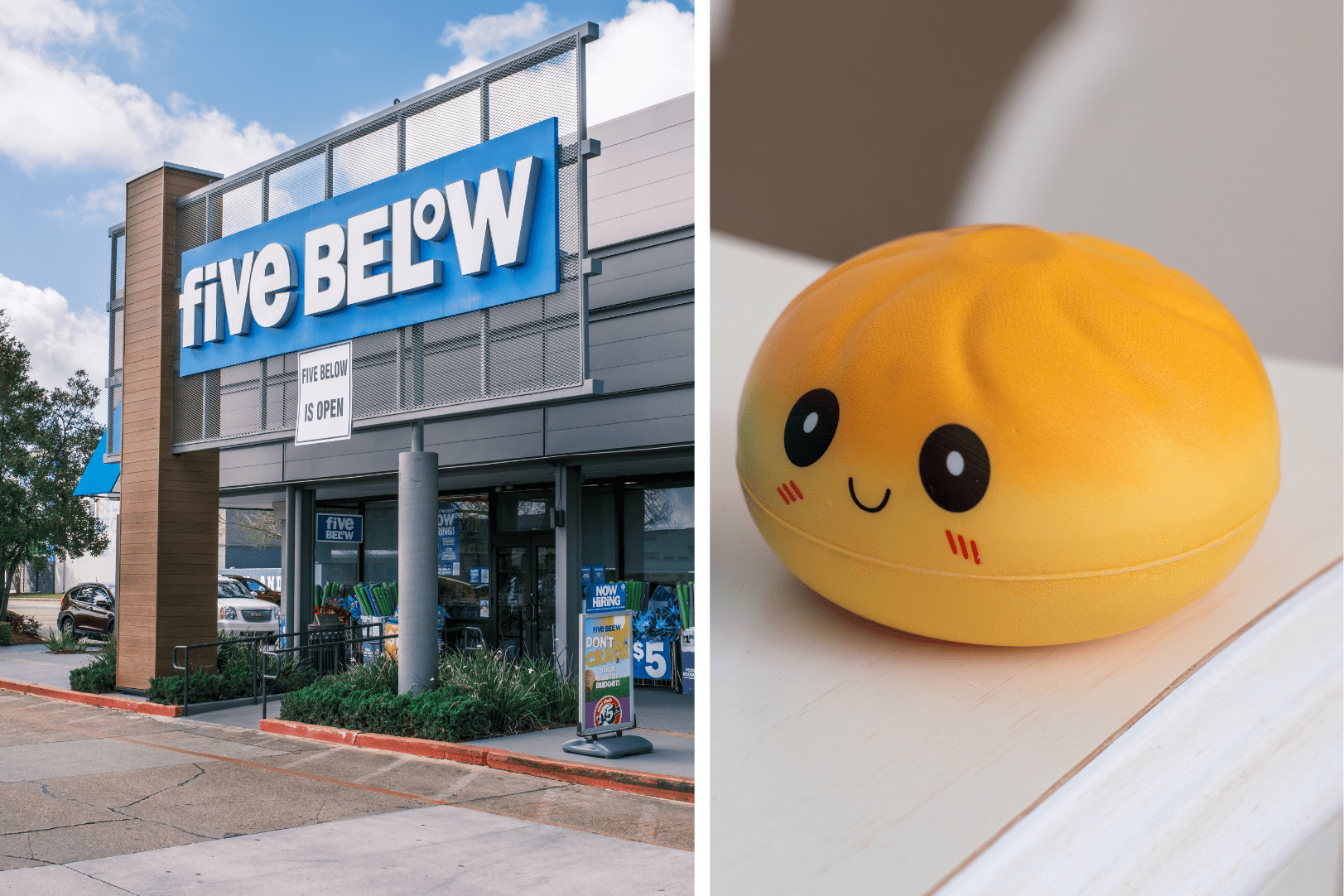
- Five Below shared details about how it capitalized on the squishy dumpling craze.
- The company added 49 net new stores in Q1.
- A deliberate pivot to social-first marketing and refreshed merchandising fueled gains across 18 departments.
- Despite the strong quarter, the company projects a sharp deceleration in the second half.
Five Below reported net sales growth of 32.5% to $1.29 billion in the first quarter of fiscal 2026, which executives said was driven by a viral toy trend, a deliberate pivot to social media marketing and a broader overhaul of how the company merchandises its stores.
In the first quarter ended May 2, comparable sales rose 22.7%, the fourth consecutive quarter of double-digit comp growth for the Philadelphia-based discount retailer for teens and tweens. Net income more than tripled to $123.1 million from $41.1 million a year earlier, and diluted earnings per share increased to $2.21 from $0.75. The company ended the quarter with 1,970 stores across 46 states after opening 49 net new locations in the first quarter.
CEO Winnie Park, who previously led Forever 21, credited the results to both strategic execution and the company’s growing ability to identify and amplify cultural moments.

“We successfully amplified social media trends and drove outsized traffic through coordinated merchandising and marketing efforts,” she said in the company’s earnings release. “Our continued focus on compelling newness at amazing value and great store execution are at the heart of our operating flywheel.”
Squishy Dumplings for The Win
Five Below did not create the squishy dumpling trend. The small, squeezable toy had been sitting in the company’s assortment for roughly five years before exploding into mainstream popularity this spring.
“I would love to say that we created the dumpling trend,” Park said on the company’s earnings call. “We started seeing it pop up in social. What we did was amplify what was becoming hot, and that is a special skill, and I do think we can use it to then create trends on a go-forward basis.”
The amplification strategy involved three steps, Park explained: social listening to identify what was gaining traction, active engagement and reposting to accelerate momentum, and then building out a broader assortment of squishy products to sustain traffic beyond the initial spike.
“It’s not the what, but the how,” Park said.
The company held a dedicated in-store squishy dumpling event in mid-May that CFO Dan Sullivan described as a “cultural zeitgeist.” However, Sullivan was careful to temper investor expectations about the event’s direct financial impact. “I would caution against the notion of this event being a meaningful catalyst to the comp profile for the quarter that we’ve built,” he said. “[It was a] one-day event, essentially, of one item with intentionally constrained supply.”
The squishy trend did affect basket dynamics. Park noted that customers drawn in by the dumpling event tended to buy smaller baskets than typical shoppers, which contributed to transaction growth of 19% outpacing ticket growth of just 4% in the quarter. “Those baskets typically are smaller than the broader baskets, and that kind of explains why you see ticket not being quite as high or equally as high as other quarters,” she said.
Social Media as a Marketing Pivot
Five Below has previously relied on traditional marketing channels. That approach has changed substantially.
“We just started on this journey with social last year,” Park said. “First steps was just trying on different types of content, both creator content, boosting UGC, and what has really, really helped us is that we have a lot of stories to tell. The marketing and merchandising teams work really closely together, pretty much from the inception of the line, and they start thinking through what would really hit.”
The company has deployed creator content, AI-generated marketing materials, connected TV advertising, and social listening tools across platforms including TikTok, Instagram and YouTube. Park said the customer database has grown at a geometric rate quarter over quarter, though she described the effort as still in early stages. Loyalty programs, potentially through an app, with features like early access to new products and reward points, are under consideration.
Sullivan said marketing spend is running about 20 to 25 basis points higher year-over-year. So far, he said, the returns justify the outlay.
“The beauty of that is we’re seeing terrific returns, and if we get to a place, in whatever circumstance hypothetically, where we are in a more challenging environment, we would obviously be able to pull that back as well,” Sullivan said.
Merchandising Shifts Drive Broad Growth
The squishy trend was a standout, but 18 merchandise departments posted positive comps. Games and toys were the strongest performers, though Park pointed to growth across candy, beauty and fashion as well.
One notable strategic shift: Five Below has moved away from an item-by-item buying mentality toward what Park described as “assortment merchandising,” which means building product stories around themes and customer needs rather than chasing individual SKUs.
The company has also restructured its pricing architecture, eliminating the “Five Beyond” brand name and integrating higher-priced items directly into the store assortment. Prices were rounded to whole dollar amounts, and the company has worked to establish clear value at price points above $5.
“We have not seen resistance on prices above $5 if we can pack enough relative value,” Park said. “The customers have definitely voted for it.”
That pricing flexibility has created new merchandising opportunities.
Store Footprint and the Online White Space
Five Below added 49 net new stores in the first quarter, reaching 1,970 locations. The company expects to open approximately 150 net new stores for the full fiscal year. Sullivan noted that new store classes from 2025 and 2026 are outperforming earlier vintages, which he attributed in part to a more selective approach in choosing locations.
Online sales grew but remain a small fraction of total revenue. Park framed the digital channel primarily as a marketing funnel rather than a direct sales driver.
“Really where we have leveraged online is the social media and influencer-creator marketing that we put out there,” she said. “It really points most customers directly to the site, which comes kind of as a window to Five Below, and drives then the traffic into the stores. Ecommerce represents an opportunity for future growth.
A Harder Road in the Second Half
Despite the strong first-quarter results, the company is projecting a deceleration for the remainder of the year. Second-quarter net sales guidance of $1.18 billion to $1.20 billion implies growth of roughly 16% at the midpoint, with comparable sales growth expected in the 7% to 9% range — a notable step down from Q1’s 22.7%.
Full-year net sales are guided to $5.4 billion to $5.48 billion, with comparable sales growth of 6% to 8%.
Several factors contribute to the cautious outlook. First, the company is cycling strong prior-year performance: the second half of fiscal 2025 featured 15% comparable sales growth. Second, pricing actions taken a year ago will have been fully integrated by mid-year. Third, the consumer environment is showing signs of strain.
Rising fuel costs, persistent inflation, and a softening labor market are all headwinds facing Five Below’s core customer base, Sullivan said. He also noted that elevated tax refunds, which boosted consumer spending in the first quarter, are not expected to repeat at the same level.
“We don’t have data that would suggest there’s trade down happening,” Sullivan said. “We don’t have data that would suggest there’s been a shift in behavior. That’s certainly not what we’re saying, but I do think we transparently have to look at the environment we’re operating in and the world our customers are living in.”
Tariffs remain an additional variable. The company’s outlook assumes that tariff rates revert to levels in place at the start of the fiscal year after a 150-day reduction period ends in late July. Sullivan said the company has taken the necessary steps to secure potential refunds under IEEPA tariff provisions but declined to quantify the potential benefit. “It is an incredibly fluid and complicated topic,” he said.
Park closed the earnings call with an eye on the holiday season, arguing that Five Below enters the second half with more product “ammunition” than it had a year ago, when tariff-related uncertainty constrained some categories. The squishy dumpling playbook, she suggested, is one the company intends to run again.
“We are constantly looking for the next new, both from the vendor community but also with the customers. What are they talking about, what’s going viral today and how do we engage with them?” Park said. “Lots in our toolkit that we’re developing this year, and that we can apply to the future.”