


Key takeaways:
- More than half of Wayfair’s in-store customers are new to the brand, a figure that surprised even company insiders and suggests physical retail is reaching consumers the website never did.
- Customers pushed back on Wayfair’s original delivery-first model, demanding the ability to take items home that day, prompting a significant shift in how the company stocks its shelves, brown boxes and all.
- Wayfair posted Q1 2026 net revenue of $2.9 billion, up 7.4% year over year.
Wayfair spent more than two decades as a purely digital retailer before it opened its first large-format store in Wilmette, Illinois in 2024. Now, with 14 stores across multiple brands, a string of openings planned for the next 18 months, and a stated goal of achieving a national footprint, the company is putting real square footage behind a bet it has been quietly building toward for years.
Liza Lefkowski, Wayfair’s VP of Merchandising and Stores, said physical retail was never really a question of whether — only when. “Stores were always part of the plan,” she said in an interview with Retail TouchPoints. “It was never a question of if; it was always a question of when.”
Three stores carry the flagship Wayfair banner: the original Wilmette location at 250,000 square feet, a store in Atlanta that opened in March and one in Columbus, Ohio that opened earlier this month at roughly 70,000 square feet. The remaining stores span three specialty brands — AllModern, Birch Lane and Joss & Main — which operate in smaller, lifestyle center-based formats ranging from 8,000 to 12,000 square feet. Perigold, the company’s luxury brand, accounts for two additional locations.

More stores are coming. Lefkowski confirmed that Denver will open later this year, followed by Westchester, New York early next year. Princeton, New Jersey, Cincinnati, Ohio and Fort Lauderdale are also in the pipeline for 2027. Upcoming Wayfair-brand stores are expected to fall in the 90,000 to 140,000 square-foot range.
The brand strategy behind store placement draws on years of online customer data. For the mass-market Wayfair banner, the logic is straightforward: go where the population is and where fulfillment centers can support fast delivery. For the specialty brands, the calculus is more nuanced. Birch Lane stores are concentrated in Florida, where the brand’s traditional aesthetic resonates with a predominantly Southern customer base. AllModern is positioned in the Boston and Chicago areas, targeting a more urban, slightly younger shopper.

AllModern in Austin, Tex. Photo courtesy of AllModern.
Bringing the Online Catalog Into a Physical Space
One of the central challenges of Wayfair’s retail expansion has been translating a catalog of millions of products into a coherent, shoppable floor. The company’s solution starts with its Wayfair Verified program, a curated subset of items that have passed quality audits and are vetted for market pricing.
“That program is meant to be our shortcut to the good stuff,” Lefkowski said. “We have millions of items on our site. How do you know which are the best ones that are the best value? That is what we are hoping to convey with this program.”
Store assortments are drawn from that verified pool, and customers shopping Wayfair’s website in markets where a store exists can see on the product page whether the item is available in person. The experience is closer to a traditional department store than to IKEA’s forced-path model — shoppers can move freely between 19 departments covering everything from upholstered furniture to home improvement. Items small enough to carry fit the cash-and-carry model; larger furniture is typically delivered within a day or two.
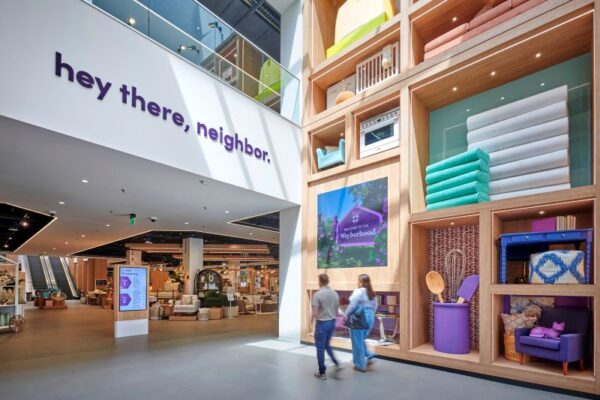
Wayfair in Wilmette, Ill. Photo courtesy of Wayfair.
What Customers Have Taught the Company
Lefkowski said roughly 75% of home furnishing transactions still happen in physical retail broadly, and Wayfair’s own store data has reinforced how much consumers value the tactile experience of shopping for furniture and home goods. But the company walked in with some assumptions that did not hold up.
The most striking finding was that more than 50% of in-store visitors are customers who are new to Wayfair entirely.
“Shocking to me, if I’m being honest,” Lefkowski said. “We went into stores with a national brand, relatively high awareness, and so I assumed that we had at least engaged with the majority of households in the U.S., but stores are telling us that’s not necessarily the case.”
The second lesson came from watching customers at the shelf. Wayfair initially assumed shoppers would accept delivery for heavier, bulkier items — a dinnerware set in a 20-pound box, for example. They were wrong.
“Customers want it on the shelf, they want to take it home that day,” Lefkowski said. “They don’t care if you can deliver it in 24 hours. They want it that day, and they’re willing to do the work.”
The company has since expanded its cash-and-carry assortment considerably, and that shift has come with a visual trade-off.
“You walk in our store, you’ll see a lot of brown boxes, because having pretty packaging is less important than being able to take it home that day,” Lefkowski said.
Stores have also surfaced gaps in how Wayfair surfaces coordinating products. Customers standing on the floor asking to see coordinating items or alternate configurations of a sofa, for instance, have accelerated internal roadmap priorities in ways that purely digital feedback had not.
The stores also offer free in-store design services, something Lefkowski said many customers, including longtime online shoppers, were unaware of before walking in.
How Wayfair Is Training Store Associates
Staffing the stores has required rethinking what to look for in candidates. Early hiring efforts focused on recruits with experience at competing home retailers, a strategy Lefkowski said produced uneven results.
“We found that did not work,” she said. “It kind of boiled down to they didn’t really marry with the culture very well.”
The company shifted to prioritizing cultural fit over industry background. “We can train them on how to sell a sofa or how to sell a mattress,” Lefkowski said. “That’s relatively easy. We can’t as easily train someone into our culture.”
Each associate is assigned a home department where they are expected to develop product expertise, whether that’s upholstery or home improvement. They receive baseline sales training but can also advance into specialist roles in categories that require deeper knowledge, such as large appliances, cabinetry, mattresses and design services. Wayfair has also used the original Chicago team to seed the culture at newer locations.
Financial Performance as Expansion Continues
Wayfair reported first-quarter 2026 net revenue of $2.9 billion, up 7.4% year over year, with U.S. revenue rising 7.5% to $2.6 billion. Active customers reached 21.4 million, a 1.4% year-over-year increase. The company posted a net loss of $105 million, though non-GAAP Adjusted EBITDA came in at $151 million, representing a 5.2% margin — the company’s best Q1 result in five years by that measure.