
Key takeaways:
- Miniso is leaning on licensed intellectual property, from “Stranger Things” to Sanrio characters, to differentiate its products and draw shoppers into physical stores.
- The company is expanding its U.S. retail footprint in 2026 by 100 stores for a total of 480 locations, eventually including large format, experiential stores in Las Vegas, New Jersey and Columbus, Ohio.
- Seasonal merchandise and limited-edition collaborations have become central to how Miniso approaches the American market.
Miniso, the Chinese variety retailer known for affordable lifestyle goods and toys, used a New York exhibition tied to its Yoyo mascot to lay out how it plans to grow in the United States.
Tom Bartlebaugh, Miniso’s U.S. CEO, said the company is targeting roughly 100 new store openings this year, a 20% increase in its current footprint of approximately 380 locations.
At the heart of the strategy are a heavy reliance on licensed intellectual property and an aggressive push into physical stores.
“As we move away from the malls, we’re really starting to move to bigger, more experiential stores,” Bartlebaugh said in an interview with Retail TouchPoints. “And the consumer has been responding quite a bit to what we’ve done and tested so far this year.”
Joined by CMO Robin Liu, Bartlebaugh described how U.S. shoppers respond more to seasonality, gravitate toward recognizable characters and franchises and increasingly treat a store visit as something closer to an outing than a chore. Miniso is trying to build a business around those habits.
Miniso’s Expanding Retail Footprint
Bartlebaugh said the company is targeting roughly 100 new store openings this year and is “well on our way, more than halfway there.”
The push is paired with a format shift. “When Miniso entered the United States, it was really opening stores in malls, and we’re really shifting out of that,” he said, citing what he described as a mall environment that is “slowly been kind of dying.”
The pivot is toward lifestyle centers and open-air power centers, with stores that are slightly larger and built around exploration.
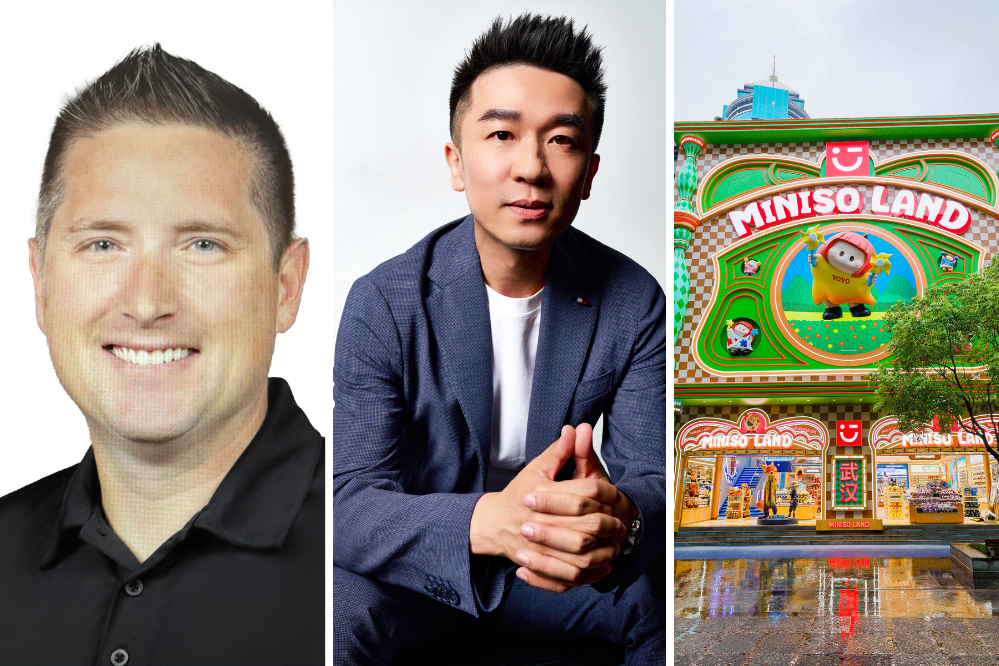
Miniso’s second iteration of U.S. stores will mimic the Miniso Land stores in the company’s headquarters in Guangzhou, China. A 15,000-square-foot experiential store is scheduled to open in late September or early October in Columbus, Ohio. The company is also doing a Miniso Friends concept store in New Jersey at the American Dream store, where it will be doubled in size. A Miniso Land store will open in Las Vegas in the first half of 2027.
“They have been staying in the stores longer, which means they’re buying more,” Bartlebaugh said of the experiential stores. The company sees physical stores as the place where its product mix and IP collaborations have the most impact, because shoppers can encounter the merchandise directly.
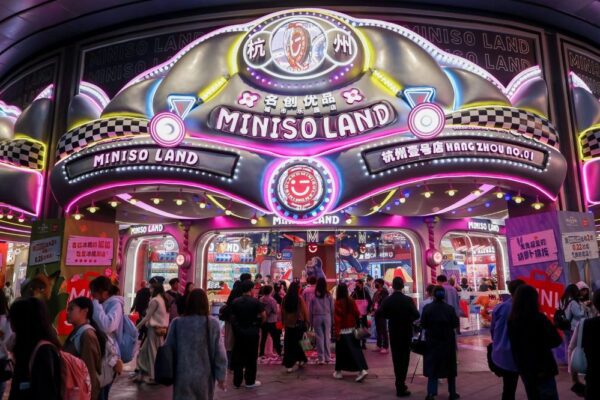
The Miniso Land store in Hangzhou, China. P
The logic is straightforward: products tied to popular characters tend to perform better when customers can see and touch them, and limited-edition items create a reason to visit in person.
Liu described stores as places where IP communities converge.
“[Customers]go in with their friends and they’re doing TikTok videos,” and treating the visit as a shared experience rather than a transaction. For a retailer built on impulse purchases and discovery, the store itself is a key part of the pitch.
What Makes the U.S. Market Different
Executives pointed to several features of the American market that shape how Miniso operates there. Seasonality plays a larger role than in some other regions.
“Retail is really driven by season,” Bartlebaugh said of the U.S. The consumer’s been trained their entire lives to shop around holidays and seasonal moments, cycling through Valentine’s Day, Mother’s Day, back-to-school, Halloween and the holidays in sequence, he said.
That pattern has direct consequences for Miniso’s merchandising.
“We might not be selling something for that specific season, but we better have something new and fresh for the consumer to see, because that’s when they’re trained to come out,” Bartlebaugh said. The result is a company that refreshes its assortments frequently and plans around the calendar more deliberately than it would in markets where seasonal shopping habits are less entrenched.
Franchises and pop culture also carry significant weight. Bartlebaugh said the connection consumers feel toward characters like Hello Kitty, Pokémon or Demon Slayer goes deeper than nostalgia or name recognition.
“People really aren’t necessarily buying or falling in love with an IP anymore just because it was part of a movie,” he said. “These IPs and these collections are really identifying that person. When I’m wearing a Hello Kitty, or I’m wearing a Pokémon, or I’m wearing a Demon Slayer, really it’s me telling you who I am as a person.”
Collaborations tied to properties such as “Stranger Things” give Miniso a way to connect with American consumers through stories and characters they already claim as part of their identity, turning each release into an event rather than a routine restock.
How IP Drives Product Strategy
Licensed intellectual property sits at the center of Miniso’s product strategy, accounting for roughly 50% of its total product mix, according to Bartlebaugh. The company partners with established franchises and character brands, then builds collections of toys, accessories and lifestyle goods around them. But executives are careful to frame the goal as something larger than licensing.
“We want to be this IP operating platform,” Liu said, describing it as the company’s core competitive advantage. That ambition shapes how Miniso approaches each partnership: rather than simply putting a character on a product, the company runs what it calls a product incubation process for each IP.
“We need to be more innovative and creative when we are creating products based on IP,” Liu said. The result is a rotating lineup that can change quickly as new partnerships come online and proprietary characters like Yoyo take on a larger role alongside licensed ones.
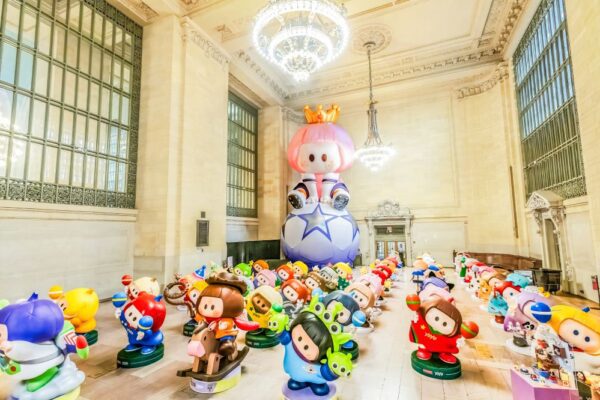
The Yoyo exhibition features 50 life-sized figures at Vanderbilt Hall in Grand Central Terminal. Photo courtesy of Miniso.
This model gives Miniso a way to stand out in a crowded field of low-cost retailers. Generic merchandise competes mainly on price, but products tied to beloved characters can command attention — and, often, a willingness to pay a bit more. The IP strategy also creates a steady reason for customers to return, since collections turn over and limited runs sell out.
The Yoyo Exhibition
The exhibition in New York, built around Miniso’s Yoyo character, served as both a marketing event and a window into the company’s thinking. Liu said the intent goes beyond moving product.
“The development of our proprietary IP is very important to communicate to our consumers through those exhibitions and events, not just about commercialization,” Liu said, adding that New York was chosen deliberately: “We believe New York is culturally influential and very lively, vibrant. It has the global impact.” Rather than simply stocking shelves, Miniso is using branded experiences to draw foot traffic and reinforce its identity as more than a discount store.