
Florists and floral wholesalers face unique pressures in the lead-up to peak periods such as Mother’s Day and Valentine’s Day, when demand for fresh blooms skyrockets.
The flowers themselves, many grown overseas, are perishable, so there are sourcing, transportation and logistics challenges in simply getting them from the farm to the retailer’s shelves. In addition to the short freshness window, the sales window is relatively brief and finite: Monday morning is too late to send mom that bouquet.
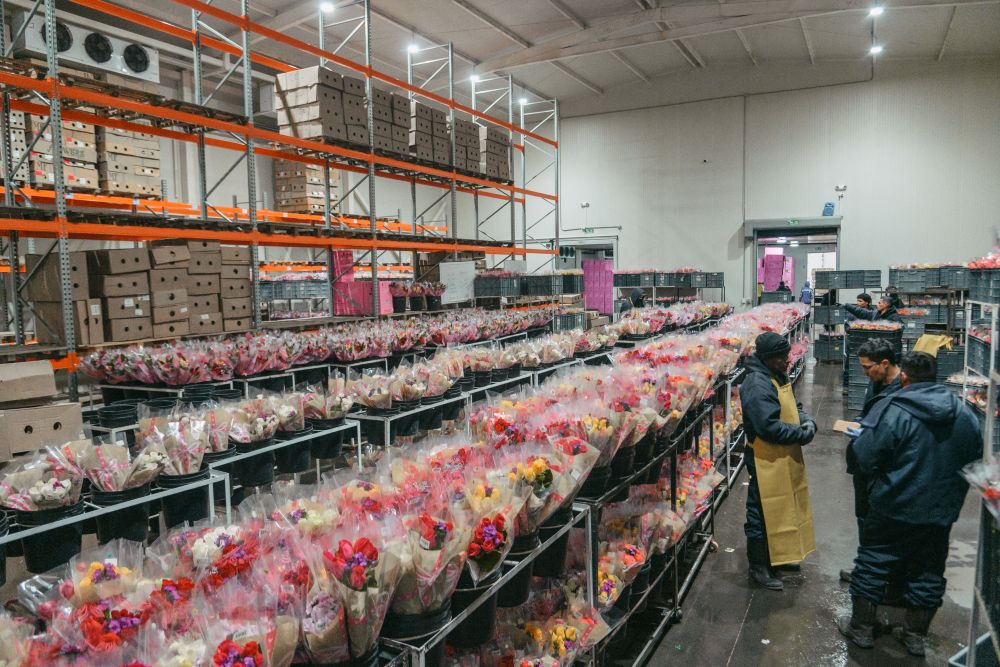
Fantasy Farms, a floral wholesaler that also offers products such as potted plants and snacks, spends months planning for these peak periods, when its typical distribution to more than 8,000 retail locations blossoms to more than 30,000 doors. Annually, the company grows more than 50 million stems across Colombia, Costa Rica, Ecuador and Mexico, and it operates a distribution center in Miami.

Daniel Sabogal, CEO, Fantasy Farms
For the peak holidays, “We’re sending flowers to every state and zip code, including Alaska and Hawaii,” said Daniel Sabogal, CEO of Fantasy Farms in a zoom interview with Retail TouchPoints from the company’s farm in Colombia. “We’re dealing with a perishable item that needs to be shipping in controlled temperatures. A lot of things can go wrong.”
And to make these processes even more complicated, demand is difficult to predict, he added, given that flowers are a discretionary purchase and also are dependent on factors like weather, both in the growing area and where they are purchased.
“There’s a good five to six months of pre-planning, and then it gets intensive three months before the holiday,” said Sabogal. “It also depends on the type of product. For example, with roses, you need to prune and plan 90 to 100 days ahead, and the flowers don’t come all at once — there’s about a 10-day window of opportunity. Then, we’re also talking to our customers about what they’re expecting to receive — in what mixes and with what different packaging solutions. We’re also in discussions with carriers such as FedEx and have to ensure we have enough people, and enough trucks, at our Miami facility to get the products out.”
This year, tariffs and the general uncertainty of global trade are adding another challenge. “We could try to pass along [the extra costs] to consumers, but given the uncertainty in the U.S., we can’t just pass it along and assume people will buy it in any case — it’s a discretionary purchase,” said Sabogal. “That puts pressure on margins.”
Retail Customers Sought Scan-Based Trading from Fantasy Farms
Given the level of these complexities, it’s somewhat surprising that Sabogal was willing to take on any additional risks. But Fantasy Farms has embraced scan-based trading (SBT), enabled via Fintech, which is a business model where the supplier maintains ownership of the product until it’s actually sold. This reduces upfront inventory costs for the retailer but, for Fantasy Farms, it represents a significant financial risk if products remain unsold.
But Fantasy Farms didn’t have a lot of choice about whether to adopt SBT, said Sabogal.
“When we started the business, we were selling traditionally, to grocery chains and wholesalers, and nobody ‘speaks’ SBT there,” he explained. However, when Fantasy Farms needed a competitive edge, it shifted its attention to non-traditional floral retailers such as convenience and drug stores. These retailers required smaller orders and presented challenges in areas such as logistics and packaging — and they also preferred an SBT business model.
“At first, I didn’t want to take the risk of SBT, but as we continued to expand with these types of customers, it became not just ‘something cool’ but something you have to do in order to get into the c-stores and drugstores,” said Sabogal. “Now it’s become our core business. Taking all the risk, on top of the ones I have growing, shipping and planning, sounded crazy, and we did it more as a survival strategy than anything. Then we became good at it.”
Scan-Based Trading Pays Data Dividends
The not-so-secret benefit of SBT for wholesalers and suppliers is that it can provide a treasure trove of data — not just overall sales figures delivered after the holiday but near-real-time, store-level sales data that allows Fantasy Farms to adjust anything from bouquet mixes to color assortments, based on what’s actually selling. Given the short sales window, these high levels of visibility can help both maximize sales and minimize waste.
Only a few traditional retailers (most notably Walmart) share such detailed store-level data with suppliers, and when Fantasy Farms began using SBT 10 years ago, “we didn’t know how to analyze all that data,” admitted Sabogal. “But we’ve been investing heavily for the past four to five years on things like attaching data to our production costs. Now the solution gives us comprehensive information on what we sold, how much we shipped, how much that cost, by store, by SKU, by season, even by the type of box it’s packaged in. It’s one of our more important tools that enable us to do this efficiently.”

Fantasy Farms’ Indigo Farm
The data and insights are helping not only with tactical achievements and processes but also with strategic analysis. “With all that data available, we look at trends and different combinations, and also do ‘what if’ scenarios,” said Sabogal. “Additionally, all that information is now built into our AI model, so we can look at it almost with a microscope. We can start playing with different fulfillment models in a more educated way, for example. We had to compile those millions of transactions that we can now integrate into our database to create a model that helps us make better decisions.”
Sabogal warned that for SBT to work for both suppliers and retailers, the latter need to do their part in terms of merchandising the flowers and displaying them to best advantage. Additionally, Fantasy Farms offers a range of other gift-style products, including snacks and potted plants, so “retailers need to be able to understand the true potential of all our products in terms of cross-selling and complementary offerings,” he said.
Fantasy Farms offers hydrated shipping boxes that can be turned into displays at the point of purchase to simplify these processes. “We rely on stores to perform and display it properly, but not all stores [we sell to] are equally capable,” said Sabogal. Additionally, if retailers are working with multiple SBT vendors, there’s a danger that sales for any one vendor’s products will be cannibalized.
“Retailers need to do their part, and ultimately, those retailers are going to benefit if we do well,” said Sabogal. “Their success is our success, and we want to give them the proper support to succeed.”