


With more than 120 million listings and millions of active sellers, Etsy faces one of the most complex curation challenges in retail. Surfacing the right products to the right shoppers at that scale requires more than algorithms alone.
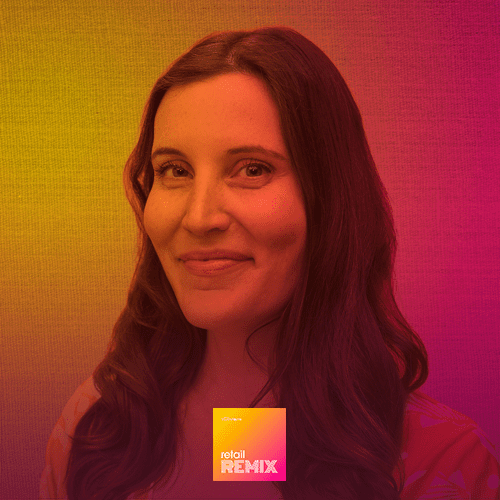
Mary Andrews, Head of Global Merchandising at Etsy
Mary Andrews, Head of Global Merchandising at Etsy, sat down with Nicole Silberstein, Editor in Chief of Retail TouchPoints, on the Retail Remix podcast to discuss how her team balances human instinct with AI-driven discovery to build a shopping experience that feels both personalized and culturally relevant.
Merchandising a Marketplace at Scale
 Andrews describes her team’s core function as translating cultural moments and buyer demand into the categories and stories Etsy surfaces across its “front doors” — the homepage, app, email, and marketing channels.
The process starts with human observation: “We start with taste, cultural instinct,” Andrews said. Her team monitors music, film releases, emerging style trends and broader cultural shifts, then layers in behavioral data, such as searches and shifts in demand to identify where interest is building.

From there, those insights feed into algorithmic training signals: “AI scales the insight; and our merchandisers ensure it’s accurately capturing their intent and that it’s resonating,” she said. “It’s really this constant feedback loop.”
‘AI Doesn’t Replace Uniqueness,’ and it can Fuel it
Etsy has built its identity around non-commodity, one-of-a-kind products. The concern that algorithms push toward sameness is a real one, but Andrews argues that Etsy’s approach works in the opposite direction.
“Algorithms can promote sameness if they’re optimized for popularity alone,” she said. “But at Etsy, AI doesn’t replace uniqueness. I think it helps surface truly personalized niche merchandising.”
Rather than programming for a single audience, Andrews said Etsy can now connect specific collections to the buyers most likely to appreciate them. Intent matters too: when a shopper has a clear goal, AI narrows quickly toward precision, but when they’re browsing, Etsy intentionally widens the aperture to encourage discovery.
To illustrate, Andrews offered an example: In the past, the team might have run one single “spring dresses” feature that every visitor would see. Now, the team seeds hundreds of spring fashion collections, each maintaining the merchandiser’s intent but scaled and personalized for a wider range of tastes, styles and occasions.
‘Algatorial’ Collections and the Human-AI Blend
One of the clearest examples of the combination of human and AI is what Etsy calls “algatorial collections.” A merchandiser seeds a collection with a specific aesthetic or point of view, and AI scales it to thousands of relevant listings while preserving the original intent.
“This has allowed us to focus on seeding a much greater variety of content across more interests and niches, while AI is taking care of matching the content to the right buyer,” Andrews explained.
Etsy also uses guided groups — combinations of keywords used to build collections around themes that rely less on visual cues, such as “seashell bridal jewelry” or “gold theme gifts for a 50th anniversary.” These collections are presented as interest modules on the homepage and expand as shoppers provide more behavioral signals.
In the past year, Etsy has restructured its merchandising team to support this model. The team now operates across three arms: vertical categories such as home and living; horizontal categories including gifts, weddings and fandoms; and a merchandising programs arm focused on 100% human curation. That last arm covers initiatives like new arrivals, “ones to watch” sellers and co-created drops with sellers and influencers.
The restructuring also introduced new roles. Merchandisers now help train and review AI models through what Etsy calls Human Quality Review (HQE) and Visual Quality Review (VQE) — teaching systems to understand quality attributes and relevance. Andrews noted that this work has improved search accuracy around attributes like material, color, dimension and size.
AI Answer Engines and New Discovery Channels
Etsy has also been an early mover in integrating with AI answer engines — including ChatGPT, Google Gemini and Microsoft Copilot — to trial selling directly on those platforms.
Andrews sees these channels as an opportunity to reach shoppers who might not have thought of Etsy as a starting point. “I’m also energized by how well these systems interpret intent, not just keywords,” she said. “When someone describes a feeling or an occasion or a vibe, I think Etsy’s positioned really well to surface something special.”
She noted that Etsy sellers are often among the first to bring emerging trends to market, and that AI answer engines may give those products immediate visibility for shoppers who don’t yet have the words to describe what they’re looking for: “You can describe what you’re looking for without naming the thing,” Andrews said.
Lessons From Depop
During the five years Etsy owned the resale marketplace Depop before its recent sale to Ebay, Andrews said the knowledge exchange between the two merchandising teams was invaluable.
“Depop has such a sharp pulse on Gen Z culture — how identity shows up through style, merch that feels relevant,” she noted. In turn, Etsy shared what it had built around scaling discovery for broader audiences. Rotation opportunities between the two teams also allowed merchandisers to develop new skills within a familiar organizational structure.
The Merchandiser of the Future
When asked about where the traditional merchandiser role is headed, Andrews was direct: the job is changing, but human taste is not becoming obsolete.
“It’s not just about selecting products anymore. It’s about shaping the systems that surface them,” she said. “AI changes the mechanics of the job, but it doesn’t replace human taste.”
Her advice to merchandisers: run toward the tools. Use AI to drive efficiency — in reporting, content scaling and trend analysis — so more time can be spent on what only humans can do: spotting cultural shifts, defining aesthetics, and identifying first-to-market trends.
“I strongly believe that the future still needs people with distinct taste and deep inventory expertise,” Andrews said. “If anything, that becomes more valuable.”
Editor’s note: Somewhat fittingly, this episode recap was developed with the assistance of AI alongside several rounds of human editing and revision.
Listen to the full episode here or anywhere you get your podcasts: