
Why Shopify merchants are rethinking post-purchase support before the next peak hits
Every ecommerce team knows the pattern. Traffic climbs, orders land, and within days the inbox fills with the same handful of questions: Where is my order? Can I change my address? What’s your return policy? Does this come in another size?
The instinctive response is to hire seasonal agents, extend hours and hope the queue holds. But the questions behind the spike are rarely new. They are the same ones answered thousands of times, and each one costs as much to answer in November as in March.
The Real Cost Sits After the Checkout
Retailers have spent a decade optimizing everything before the “Buy” button: ads, landing pages, checkout flow. Post-purchase is where the margin quietly leaks. A shopper who has paid and now waits for an answer is at their most anxious and their most loyal-or-lost.
For Shopify merchants the problem is sharper. The platform makes it easy to launch fast and scale quickly, but support rarely scales with the storefront. A lean team that handled 50 orders a day comfortably is suddenly handling 500, with the same two people and the same help desk.
Why Legacy Chatbots Didn’t Fix It
Rule-based bots promised relief but delivered rigid decision trees, dead-end flows and a “talk to a human” button that appeared too late. What has changed is that automation can now be trained on the merchant’s own knowledge, such as help center, FAQs, policies and past conversations, rather than a script.
It can answer in your terms, not generic ones.
A Different Model: AI That Knows the Business and Knows When to Step Aside
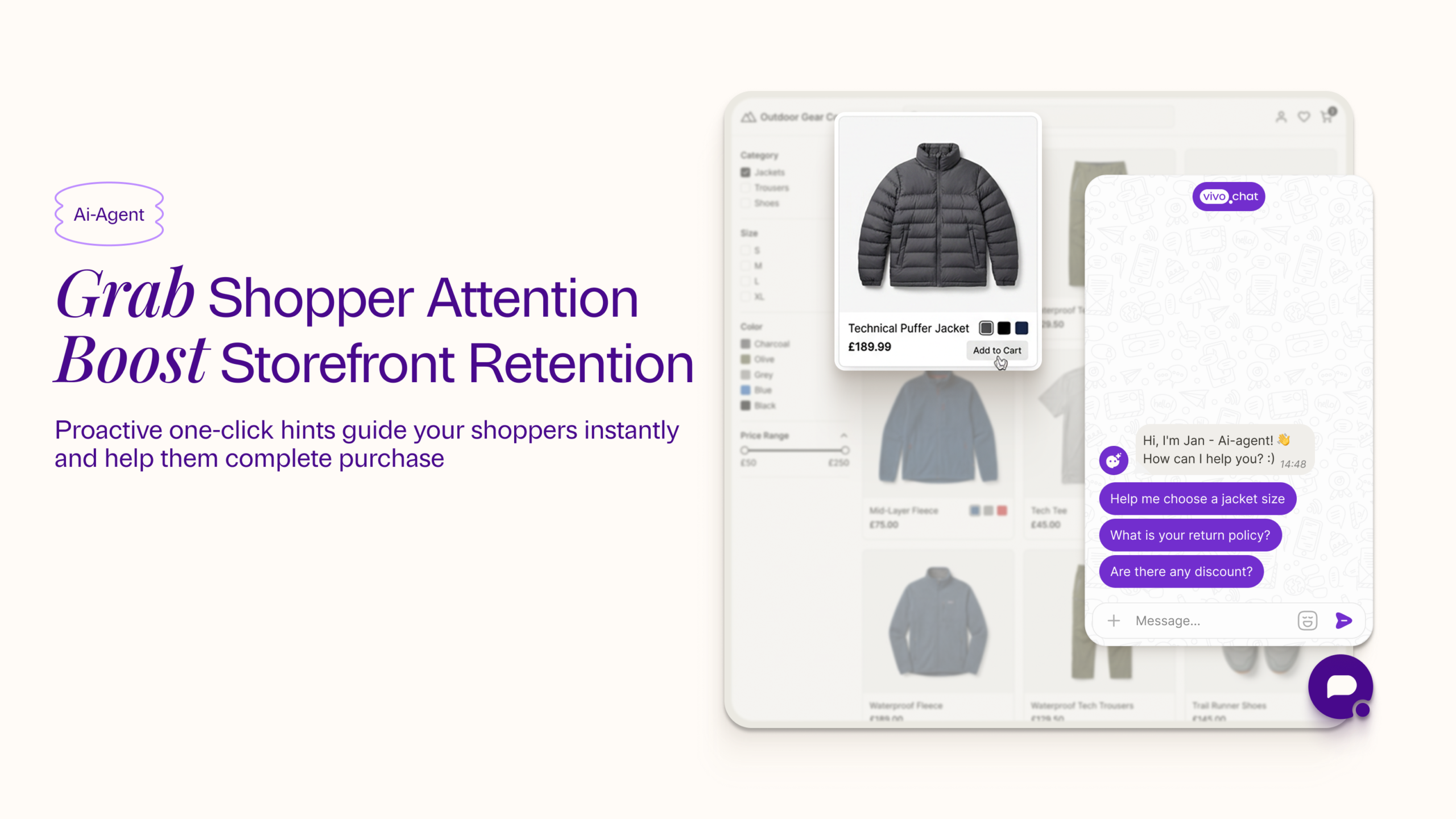
This is the approach behind VivoChat, an AI customer support platform built for online businesses. Instead of a fixed flow, the assistant is trained on a merchant’s documents, FAQs, help center content and previous conversations. It answers repetitive questions around the clock, collects the data a human agent will need, and hands complex cases to a person with the context already attached.
For ecommerce teams, three capabilities matter most:
- Fewer “where is my order” tickets. Connecting shipping tools lets the assistant answer WISMO questions directly instead of routing them to an agent.
- Support that sells. A shopping assistant can recommend products and suggest relevant add-ons in the same conversation where a shopper is already asking questions.
- Subscription-aware answers. For subscription brands, integrations with tools such as Recharge, Skio and Loop let the assistant handle common subscription requests.
Conversations also don’t stay trapped on the website. VivoChat covers site chat, email, WhatsApp, Telegram and Messenger, so customers can reach a brand where they already are.
Built to fit a Shopify Stack
For merchants, the practical barrier to AI support is often implementation time. VivoChat is available through the Shopify App Store and is designed to install without code, so a small team can get running before the next promotion instead of after it.
According to VivoChat, merchants can automate up to 70% of repetitive conversations from day one, with the assistant resolving up to 53% of support requests and an average first response time of around 30 seconds. VivoChat also cites support cost reductions of up to 50%. Results will vary with catalog complexity, policy clarity and the quality of the knowledge the assistant is trained on.
Support is Becoming a Team of Agents, Not a Single Bot
A second shift raises the stakes. Shoppers increasingly start with an AI assistant instead of a search bar, asking it to compare products or summarize return policies before they ever reach a store. Those assistants will read what a merchant publishes, so policies buried in PDFs and contradictory FAQs now hurt twice: once with shoppers, and again when an AI misreads them.
It also changes what support automation should mean. Retail support is really several jobs, from pre-sale questions and order status to billing, onboarding and retention, each with its own data, rules and escalation paths. VivoChat‘s answer is an agent marketplace: alongside the core assistant, businesses can install specialized agents published by partners for billing, onboarding, sales and retention. A Shopify merchant can start with order status and FAQs, then add a retention agent ahead of a subscription push.
The benefit is focus. A narrowly scoped agent is easier to test, easier to trust and easier to hand off to a human, so support grows in modules as the business does, instead of in headcount.
What to Do Before the Next Peak
Whatever tool a retailer chooses, the planning question is the same. Instead of asking “how many agents do we need for peak?”, ask “which of our tickets should never need an agent?”
- Audit your top 20 ticket types. Most teams find the majority are repetitive and answerable from existing content.
- Fix the source material first. An assistant is only as accurate as the help center, policy pages and FAQs behind it. Treat that content as infrastructure.
- Define the handoff. Decide which cases, such as refunds above a threshold, damaged goods or VIP customers, always go to a human.
- Measure beyond deflection. Track resolution quality, repeat contacts and revenue influenced, not only ticket volume.
Peak season will keep testing support teams. The merchants who handle it best won’t necessarily be the ones with the biggest bench of agents. They will be the ones that stopped paying humans to answer the same question for the thousandth time.
VivoChat is an AI customer support platform built for online businesses. Trained on a merchant’s own help center, FAQs, policies and past conversations, its assistant answers customer questions around the clock across website chat, email, WhatsApp, Telegram and Messenger, and hands complex cases to a human with the context attached. Merchants can also add specialized agents from the VivoChat marketplace, for billing, onboarding, sales and retention. VivoChat is available in the Shopify App Store and installs without code. Learn more at vivochat.ai.