

Key takeaways:
- Four retailers raised their full-year forecasts, even as they ranged widely on where actual sales momentum stood.
- Underlying demand varied widely across the four retailers, from record growth at Abercrombie & Fitch to continued sales declines at Kohl’s and Bath & Body Works.
- Williams-Sonoma and Abercrombie posted broad based comparable sales gains driven by product, collaborations and market share wins, not by the tariff refunds each company also received.
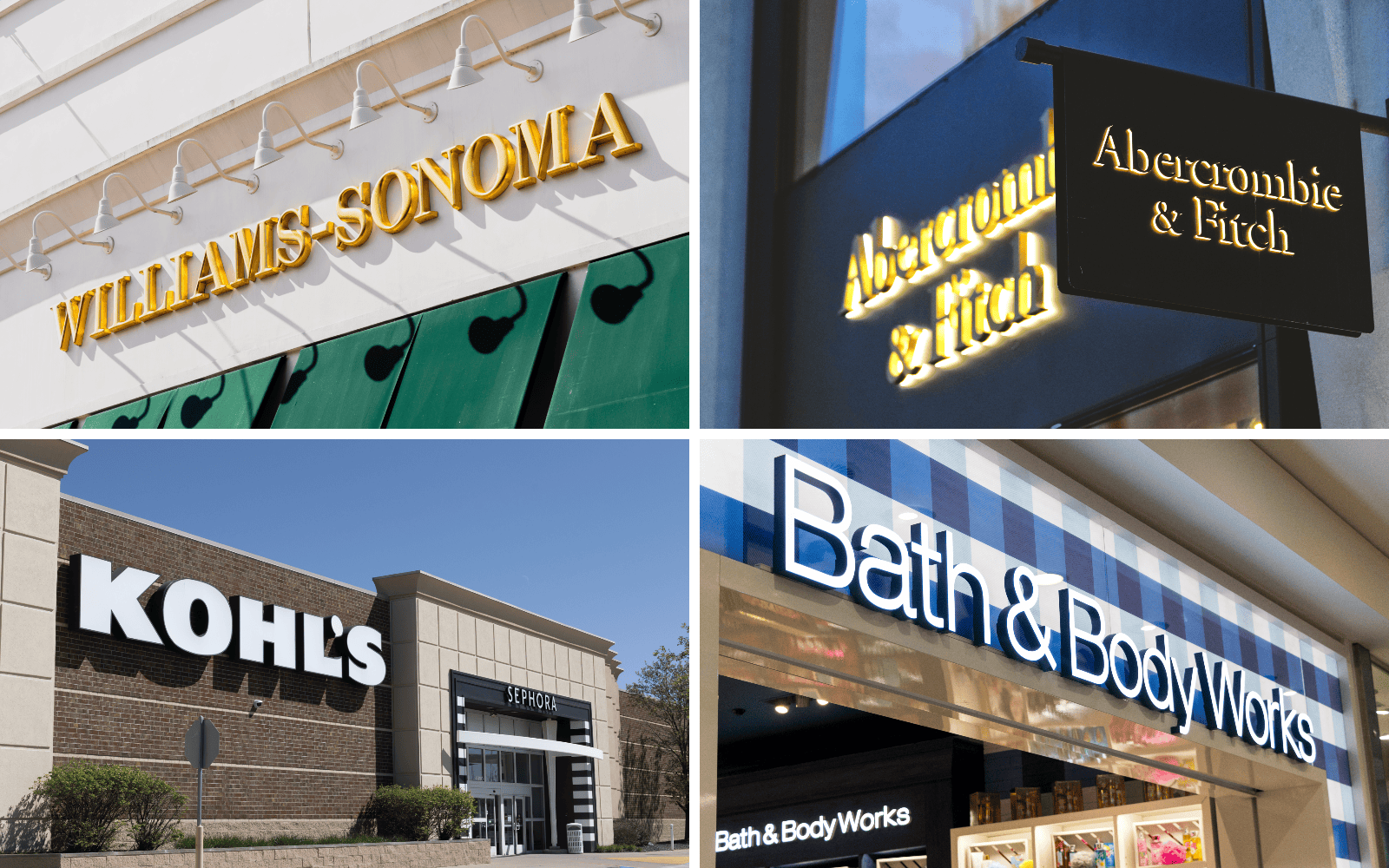
Four major retailers reported second quarter fiscal 2026 results on Aug. 26, and all four raised their full-year forecasts, even though the top line results underneath that guidance ranged widely.
Abercrombie & Fitch Co. posted its 15th straight quarter of sales growth.
Williams-Sonoma, Inc. accelerated its comparable sales in a home furnishings market executives described as flat.

Kohl’s Corporation and Bath & Body Works, Inc. both logged another quarter of declining net sales, though each pointed to sequential improvement in specific parts of the business.
All four also received refunds tied to previously paid tariffs under the International Emergency Economic Powers Act, which lifted gross margin and earnings. In every case, management distinguished between that one-time benefit and how the underlying business actually performed.
Williams-Sonoma Accelerates as Market Stays Flat
Williams-Sonoma sales reached $1.96 billion for the quarter ended Aug. 2, up 6.7% to last year, with comparable brand revenue accelerating to 6.2% from 4.8% in the first quarter.
Chief Financial Officer Jeff Howie told analysts the broader home furnishings industry was essentially flat in the quarter, meaning the company’s growth came almost entirely from taking market share.
Every brand posted positive comparable sales:
- Williams Sonoma: up 7.6%
- West Elm: up at 6.4%
- Pottery Barn: up 5.1% on stronger furniture sales and refreshed photography and storytelling
- Business to Business: up 14.5% to a record quarter
- Emerging Brands including Rejuvenation: up double-digits
CEO Laura Alber pointed to how much room the company still has to grow, noting that no single retailer controls much of the highly fragmented home furnishings category and that even a two-point market share gain would be worth roughly $16 billion, roughly double what Williams-Sonoma currently books in annual sales.
Gross margin came in at 45.5% on a non-GAAP basis, down 160 basis points, as tariff costs pressured merchandise margins. Net income reached $338.1 million on a GAAP basis, boosted by a $200 million tariff refund the company received during the quarter. Excluding that refund, non-GAAP diluted earnings per share rose 5% to $2.10.
The company raised its full-year forecast for both revenue and margin, and executives said the guidance reflects operating momentum rather than the tariff refund.
Bath & Body Works Sees Digital Return to Growth
Sales fell 2.3% to $1.514 billion for the quarter ended Aug. 1, though that was a smaller decline than the company’s prior forecast of down 5% to 3%.
Direct channel sales rose 3%, the brand’s first quarter of digital growth since 2021, which executives credited to a lower free shipping threshold and improved site personalization.
Bath & Body Works also launched a new body care franchise, Fruit Fusion, with actress Hilary Duff, and said sales on Amazon more than tripled from the first quarter as it expanded into about 600 Ulta Beauty stores. The company also said it will exit its home care category, including laundry and kitchen products.
CEO Daniel Heaf said the company is deliberately holding off on becoming more promotional to drive sales in the back half, even with store traffic still under pressure, betting instead that continued product innovation and marketing investment will rebuild demand more durably than deeper discounting would.
Gross profit rate was 45.7%, which included roughly $80 million in tariff refunds. Excluding that benefit, the gross profit rate would have been 40.4%, down 90 basis points on lower sales. Net income was $118 million, up from $64 million last year, and adjusted earnings per diluted share reached $0.62, or $0.31 excluding the refund.
The company raised its full-year adjusted earnings forecast to $2.60 to $2.80 per share and narrowed its sales forecast to a decline of 4% to 2.5%.
Abercrombie & Fitch Notches Record Quarter, Return to Comp Growth
Net sales reached $1.267 billion for the quarter ended Aug. 1, a record for the period and up 5% to last year.
The Abercrombie brand returned to comparable sales growth, up 4%, while overall net sales for the brand rose 8% on stronger conversion and less discounting.
Hollister net sales grew 2% despite comparable sales down 3%, which executives attributed to demand outpacing available inventory during the quarter, with growth expected to accelerate as inventory catches up. The brand’s new partnership with Target, its first major U.S. wholesale expansion, also contributed to growth.
Chief Financial Officer Robert Ball said the stronger pricing the company saw in the quarter came alongside unit growth, not just fewer markdowns, which he pointed to as evidence the assortment itself is resonating with customers rather than the results simply reflecting less discounting.
Net income attributable to the company was $183.7 million, up nearly 30% from $141.4 million a year ago, with diluted earnings per share of $4.17. The quarter included roughly $100 million in IEEPA tariff refunds, though executives said the core business also outperformed its own outlook by a wide margin.
The company raised its full-year net sales forecast to growth of around 5% and increased its share repurchase plans to at least $500 million.
Kohl’s Sees Best Traffic in Years as Card Customer Returns
Net sales fell 0.9% to $3.3 billion for the quarter ended Aug. 1, with comparable sales also down 0.9%, coming in below Wall Street’s forecast of $3.4 billion even as earnings per share beat estimates by a wide margin.
Executives said store traffic showed its best performance in years, nearing 2019 levels, helped by a 1% sales increase among loyal Kohl’s Card customers after a long stretch of declines.
Home led all categories with 1% growth, juniors rose 10% for a third straight strong quarter, and Kohl’s Marketplace sales jumped 88% as the company expanded third-party assortment.
Sephora at Kohl’s sales fell 4%, which the company attributed to several of its larger beauty brands expanding into other retail channels, giving shoppers more places to buy them beyond Kohl’s.
CEO Michael Bender described a core customer still weighing gas, food and heating costs against everything else and said that picture hasn’t changed since the first quarter, a dynamic shaping how the company is planning pricing and promotions into the holidays.
Gross margin rose 305 basis points to 43%, helped by roughly $150 million in tariff refunds, about $100 million of which flowed through gross margin. Net income was $151 million, close to the $153 million reported last year, which had included a $129 million legal settlement gain.
The company raised its full-year comparable sales forecast to a range of down 1.5% to flat and said it will restart share repurchases of up to $100 million, its first buyback since 2022.