

Key takeaways:
- Caraway announced its largest retail expansion to date on July 13, launching in more than 500 Walmart stores and extending same-day delivery to roughly 50% of the U.S. population.
- Since launching online in 2019 with six SKUs, the New York City-based brand now carries more than 750 products and has served more than 2.5 million households, with wholesale now its fastest-growing channel.
- Groupe SEB USA and Meyer Corporation filed suit against Caraway in February 2026 over its non-toxic marketing claims; founder and CEO Jordan Nathan says it hasn’t changed how the company operates.
Jordan Nathan didn’t start Caraway to build the biggest cookware company in America. He started it, he said, because the products he found on shelves weren’t good enough.
“When we launched, non-toxic was something consumers wanted with very little options on the market,” he said in an interview with Retail TouchPoints, referring to Caraway’s cookware, which is non-stick and made without “forever chemicals” such as PFAS.
That mission, at its core, is why the brand Nathan founded in 2019 is now on the shelves of more than 500 Walmart stores across the country.

“Today it’s a baseline consumer expectation, and that mirrors what we’ve seen in every other category: moving to organic within food or removing sulfates from shampoo or switching from polyester to organic cotton,” he said.
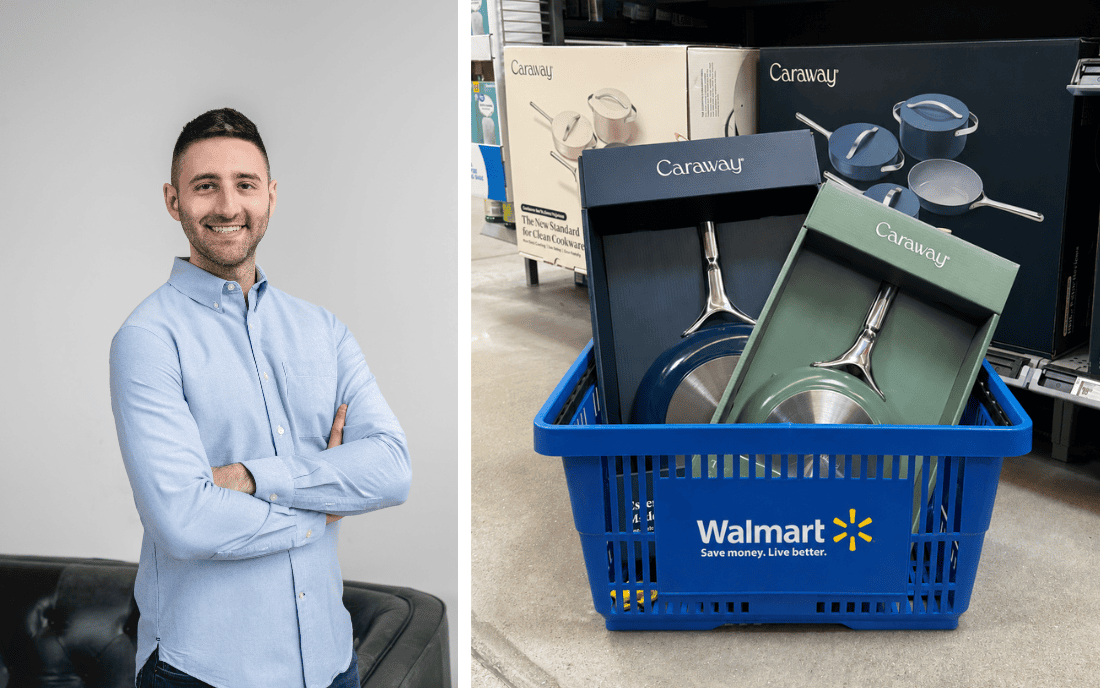
The July 13 Walmart launch is Caraway’s largest retail expansion to date and puts its cookware within reach of same-day delivery for approximately 50% of the U.S. population.
It’s a significant moment for a brand that started as a direct-to-consumer (DTC) play with a six-item catalog and has grown well beyond what he imagined. It also comes at a complicated time: Caraway is simultaneously navigating a federal lawsuit from two of the largest cookware conglomerates in the world over its non-toxic marketing claims.
Nathan spoke about the Walmart deal, the company’s broader wholesale strategy, how he’s allocating capital and what the litigation means for Caraway’s future.
How Caraway Has Grown Since 2019
Since launching, Caraway has now served more than 2.5 million households and has expanded its catalog from six original SKUs to more than 750.
The brand also holds more than 400 patents issued and pending worldwide. On the retail side, Caraway started with a single wholesale partner, Crate & Barrel, and has since expanded to Target, The Container Store, Costco, Macy’s, Dillard’s and Amazon, in addition to the new Walmart footprint. Nathan said the Walmart rollout takes the brand’s door count to more than 1,400.
Wholesale is now Caraway’s fastest-growing channel, a notable shift for a brand that built its foundation on DTC.
“For us, this isn’t about moving away from DTC,” Nathan said. “DTC is still the foundation of the business because it’s where we build the deepest relationship with our customers. Partnering with Walmart is about expanding awareness and making it easier for people to experience the brand for the first time.”
The Walmart deal specifically extends Caraway’s geographic reach beyond the coastal, urban customer who discovered the brand early.
“That kind of geographic reach is something you simply can’t achieve through DTC alone,” Nathan said.
Retail, he added, also changes how the brand has to communicate.
“The biggest difference is that your product has to tell the story on its own,” he said. “When someone visits our website, we have a lot more opportunities to educate them. In retail, you have a few seconds to capture someone’s attention, so packaging, merchandising and product presentation become incredibly important.”
Where Caraway Is Putting Capital
Caraway is investing in three main areas: product development, operational infrastructure and marketing, though not in the way some brands approach the last category.
“Our biggest investment is still product,” he said. “We have a really active innovation pipeline built out to 2030, and a lot of our focus is on developing new materials and expanding into additional areas of the home.”
On operations, he acknowledged that growth comes with backend costs that don’t always make headlines. “As you expand into more retailers and reach more customers, your operations, supply chain and fulfillment have to scale with you,” he said. “Those aren’t always the most visible investments, but they’re some of the most important.”
When it comes to marketing, Nathan pushes back on the idea that bigger ad budgets drive better outcomes. “We’ve never believed growth comes from simply spending more money on advertising,” he said. “We’ve always invested in great product design, strong storytelling and consumer education. When people understand what they’re buying and why it matters, that’s what builds trust and long-term loyalty.”
Groupe SEB Allegations
When Caraway launched, Nathan says the non-toxic category was a niche. Now, eight states have moved to restrict PFAS in cookware, he said.
Caraway positions its competitive advantage around three pillars: independent third-party testing for more than 600 PFAS and more than 20 heavy metals, design and retail accessibility. “Anyone can put the words non-toxic on a label,” he said, “but backing them with testing, design and access is much harder to copy.”
In February 2026, Groupe SEB USA, the maker of T-Fal and All-Clad, and Meyer Corporation, which owns Farberware and Rachael Ray, filed suit against Caraway in the Southern District of New York. The complaint alleges false advertising, commercial disparagement, trade libel and unjust enrichment, taking issue with Caraway’s marketing characterizations of PTFE-coated cookware. The plaintiffs are seeking an injunction, corrective advertising and disgorgement of Caraway’s profits.
The plaintiffs argue that by saying its cookware is PTFE-free, Caraway is implying that PTFE is harmful.
“…While some types of PFAS can be harmful to humans when used under ordinary conditions, PTFE is not,” reads the complaint. “Thus, Caraway plants, and preys on, consumer fears based on problems associated with some PFAS chemicals to deceive targeted consumers into believing they must purchase products that do not contain any chemical, even if it is completely safe, simply because it happens to be a type of PFAS.”
Nathan said the lawsuit has not impacted the company. “Honestly, it really hasn’t changed how we run the business,” he said. “If anything, it reinforced why transparency matters. Consumers want clear information about the products they’re buying, and we’re going to continue giving them that. We aren’t changing how we communicate because of a lawsuit. We’re going to keep doing what we’ve always done: building great products, educating consumers and letting them make informed decisions for themselves.”
What Comes Next for Caraway
International expansion is on Nathan’s radar, but the company isn’t there yet.
“Our immediate priority is depth in the U.S. rather than a rush overseas,” he said. “Demand for non-toxic products isn’t a U.S.-only story, so there’s real long-term opportunity. We’re just being disciplined about the sequencing.”
On product, Caraway has already moved well past cookware, adding bakeware, food storage, prepware, linens, stainless steel, cast iron and home organization. Nathan says new categories will continue to come.
“People know us for cookware, but we’ve always thought much bigger than that,” he said. “We want Caraway to become the brand people think of when they’re looking for thoughtfully designed, healthy products throughout the home. That’s been the vision from the beginning. Every new product, every retail partnership and every investment we’re making is really in service of that bigger goal.”