
Key Takeaways:
- Independent grocers risk losing their primary competitive advantage, which is customer intimacy, if national chains use AI to replicate that experience at scale.
- Breez AI is shifting the grocery shopping model from product-based searches to occasion- and meal-based planning, with tools that factor in store inventory, dietary needs and budget.
- Zlotnitsky warns that choosing the wrong AI partner could be more damaging to the independent channel than choosing no AI at all.
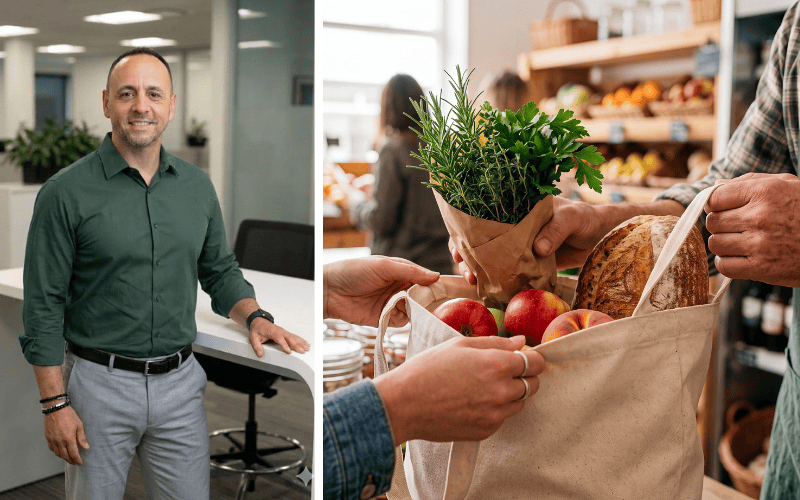
Independent grocers have long competed on something national chains can’t easily manufacture: knowing their customers by name. Tal Zlotnitsky, founder and CEO of Breez AI, believes that advantage is now at risk, and that artificial intelligence is both the threat and the potential remedy.
“AI can create the illusion of intimacy, and national chains will take advantage of that,” Zlotnitsky said in an interview with Retail TouchPoints on the Retail Remix podcast. “They’re going to create an experience that is faux intimate with customers.”
Zlotnitsky shared more about what Breez AI is building for regional and independent grocers and why he believes the stakes extend well beyond technology adoption.
A Market Segment Left Vulnerable
Zlotnitsky came to the grocery space through decades of experience in wholesale distribution. His previous company, iControl Data, operated with more than 20,000 retail doors before being sold in 2023. As he considered his next move, he said the direction became clear.
“It was fairly evident that the haves, the national chains, the large third-party fulfillment platforms, they will take advantage of what AI brings to the table,” he said.
He pointed to retail media as a specific pressure point. AI, he argued, opens the door to contextual advertising that benefits the largest platforms disproportionately, allowing them to generate more retail media revenue and use it to widen pricing gaps with smaller competitors.
Independents, he said, have historically not invested heavily in ecommerce, treating it as secondary to the in-store experience. That calculation is no longer viable. “The only place in grocery where we’re seeing significant growth is online,” Zlotnitsky said. “Looking at online as an afterthought is a risk that independents probably cannot afford to take.”
Who Owns the AI Owns the Customer
Zlotnitsky has become outspoken on one particular question: not whether AI will reshape grocery, but whose AI will do it.
“The battle for grocery is largely occurring, or increasingly occurring, before the shopper ever enters the store,” he said.
He outlined three questions he believes every independent grocer should ask any AI partner. First, where is the shopper being authenticated and where is that information stored? Second, whose system is getting smarter from the conversations? Third, is the party providing the technology competing with the grocer or powering its competitors?
“If you can answer those comfortably, then it’s probably safe to say you own your AI,” Zlotnitsky said. “If you cannot, then you’ve got to ask yourself who does.”
Breez AI’s governance structure is central to his pitch. Associated Wholesale Grocers, described by Zlotnitsky as the largest independent grocery cooperative in North America, is the company’s largest investor. The cooperative’s CFO sits on the Breez AI board, and former AWG President and CEO David Smith serves as chairman.
“David made it very clear to me that he would not get involved in anything that did not benefit independents and protect independence,” Zlotnitsky said.
He also noted that Breez AI does not operate a marketplace and has no plans to build one, and that it does not supply national chains that compete with its customers.
From Shopping Lists to Occasion Planning
The features Breez AI has developed reflect a broader shift in consumer behavior that Zlotnitsky said the company has observed directly through its chat tools.
“I don’t wake up in the morning thinking, you know what I really want today? I want to buy a jar of marinara,” he said. “I might think I want to make my family my pasta dish with meatballs, or I’ve got guests coming tonight.”
Zlotnitsky believes the traditional shopping list is on its way out. In its place, he envisions consumers describing their week, their dietary constraints and their occasions, then letting AI assemble the appropriate basket. “I think the shopping list is going to disappear,” he said. “It’s going to end up being more of a build list.”
Breez AI’s platform generates meal recommendations based on what a specific store actually carries, rather than pulling recipes from the broader internet that might require ingredients unavailable in a given region. The tool also incorporates dynamic discounting, scanning available coupons based on the occasion a shopper describes.
Budget management is also built in. Shoppers can set a spending limit and receive a full weekly meal plan built around it. Basket size data from early users offers one early measure of the tool’s impact: customers who adopted the platform had basket sizes approximately 20% higher than a peer group not using it. Zlotnitsky attributed the increase to those shoppers previously splitting purchases across multiple retailers.
Caution on Agency and Ownership
Not every direction in AI excites Zlotnitsky. He expressed skepticism toward tools designed to remove consumers from decision-making entirely.
“I don’t believe that consumers want AI to do everything for them,” he said. “I think what they’re looking for is efficiency, time saving. But they want to retain agency.”
His larger concern, though, centers on the choices independents make when selecting technology partners.
“It’s data now that’s as much of a product as anything,” Zlotnitsky said. “To the extent that independents make wise choices, there’s not much to fear. If they don’t, frankly, I think it could be quite damaging to the prospects of the independent channel.”
Looking 10 years out, Zlotnitsky said a successful outcome would mean a still-viable independent grocery sector, with roughly 25% or more of total grocery sales. He also pointed to a consumer-side goal: helping shoppers reduce food waste, save money and eat better.
“If 10 years from now those two things are true, that would feel like a great win.”