

Key Takeaways:
- AI-powered search and discovery tools are showing measurable conversion gains, with retailers such as Lowe’s reporting nearly 3X higher conversion rates among customers who use its AI assistant compared to standard site or app navigation.
- Retailers are shifting from task-level AI pilots to broader, cross-functional process redesign, using agentic AI to rethink how entire workflows, from new store openings to merchandise planning, get done.
- As holiday 2026 approaches, executives say the priority is scaling and stabilizing what’s already working, not launching new experiments, while keeping a close eye on how AI-driven discovery affects traffic, conversion and basket composition.
Retailers are moving past the pilot phase with AI. The tools are live, the results are starting to come in and some retailers are what works before the holiday season hits.
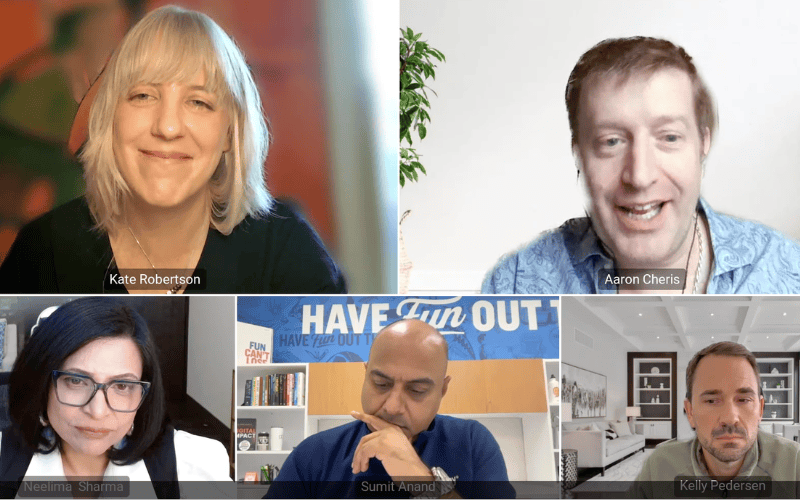
That was the central message at “The AI Retail Stack: What Retailers Are Testing and Scaling, and What It Means for Peak Season,” a webinar held Aug. 25, 2026, and moderated by Kate Robertson, Editor in Chief of Retail TouchPoints. Panelists included Neelima Sharma, SVP Omnichannel and Ecommerce Technology at Lowe’s; Sumit Anand, EVP and CIO at Academy Sports + Outdoors; Aaron Cheris, Partner and Global Head of Retail at Bain and Company and Kelly Pedersen, Partner and Global Retail Leader at PwC. A replay is available on demand via the ON24 platform.
The Four Key Conversations About AI and Retail
Cheris opened the discussion with a framework for how he sees AI playing out across retail. He identified four distinct conversations:

- using AI to do existing work more efficiently.
- building genuinely new capabilities.
- preparing for the threat of disintermediation through agentic search.
- getting data foundations in order to support all three.
“The fastest visible returns come from when AI is augmenting an existing workflow,” Cheris said. “An associate gets faster, a marketer gets content faster or a service agent resolves an issue more efficiently. But none of those require a workflow change or an operating model change.”
The harder, longer-term work, he said, involves rethinking processes from the ground up. “If we redesigned the process today, knowing AI existed, how would we structure it differently?”
Pedersen echoed that shift. Retailers are moving away from function-by-function and task-by-task AI deployment, he said, toward using agentic AI to address larger, cross-functional processes.
“What we’re seeing now is a lot of retailers really think about how can I identify this entire workflow that affects a lot of people and a lot of processes and think about it as one flow,” Pedersen said.
Measurable Wins in Search and Discovery
On the consumer side, AI adoption is accelerating faster than most retailers anticipated. Pedersen pointed to PwC survey data showing that 73% of parents planned to use AI at some point in their back-to-school shopping journey this year. “We asked that same question last year, it was in the single digits,” he said.
Cheris cited performance data from major retailers to illustrate the conversion impact of AI-powered search. He noted that Amazon has reported customers who use its onsite agents are 48% more likely to convert, spend 21% more and have 40% higher average order sizes. Walmart reported that customers who used its Sparky assistant spent 40% more per order than those who didn’t.
“It’s not just that I get to a better answer, but that better answer actually makes the shopper more likely to convert and more likely to spend more,” Cheris said.
Anand shared a similar dynamic at Academy Sports + Outdoors, where the retailer launched Scout, an agent-based search assistant, last year. Instead of typing in a product name, customers can describe what they’re trying to accomplish, such as planning a camping weekend, and Scout surfaces relevant products across multiple categories they may not have thought to look for.
“With this agent now it’s more exploratory, it’s more ideation, it’s more inspiration,” Anand said. “It’s more. I call it the ‘I wish I knew’ moment.”
Lowe’s Builds Around a Three-Part Framework
At Lowe’s, the AI strategy centers on three questions: how customers shop, how the company sells and how it works internally. That framework, Sharma said, shaped how the retailer built and evolved its AI platforms to support each area.
The most visible output of that effort is Mylow, an AI-powered assistant available to customers through the Lowe’s app and website. A companion version, Mylow Companion, is designed specifically to give associates access to home improvement expertise across every product category, no matter which aisle they’re in.
“The expertise required to serve the customer across those categories is really difficult. You just can’t create a super associate like that,” Sharma said. “Mylow Companion brought all that expertise to our associates to be able to help the customer no matter which aisle they were in.”
Milo also retains context from previous customer interactions, including details like yard type, pet ownership and home address, so recommendations become more relevant over time.
The results have been notable. “Our conversion of customers who are actually discovering and solving their problem using Milo is almost 3X compared to the site conversion or the app conversion,” Sharma said.
Data as a Product, Not a Two-Year Project
Anand described how Academy Sports + Outdoors approached the data foundation challenge by reframing it. Rather than treating data readiness as a prerequisite to AI, the team built what it calls “data as a product,” an iterative 12-week cycle in which a dedicated pod identifies a high-value use case, assembles the relevant data elements, launches a model and evaluates whether it’s delivering results.
“We’re not going to get use cases to life just because I woke up with a brand new idea this morning,” Anand said. “We’re going to bring the use cases to life that will drive the value.”
He framed the work across three buckets: foundational infrastructure that has to be maintained, core system modernization that keeps the business running and emerging tech, including AI and machine learning, that sits on top of both and generates actionable insight. “Emerging tech is what will ride on these foundational systems, but it always gives you the insights you really, really need to grow the business,” he said.
The goal, Anand added, isn’t to land every use case. “If you can work on 20 use cases a year and if you can just land two of those on the business value, you really achieved your purpose.”
Store Operations Emerge as a Surprise Win
One of the more unexpected findings from Pedersen’s work with retailers is that store operations has become one of the highest-impact areas for agentic AI.
“One of the last places I ever imagined talking about was store operations,” he said. “But it’s interesting, we’ve actually seen so much success with taking portions of the store operations process organization and infusing it with especially agentic AI.”
PwC has worked with retailers to build what Pedersen described as store operation assistants, tools that help district managers, area managers and store teams process data, communicate across layers of the organization and respond to what’s happening on the floor in real time.
Pedersen also pointed to a shift in how merchants and buyers are working. Agentic tools are now giving less experienced buyers access to raw data on supplier input costs, category trends and brand performance, allowing them to negotiate more effectively with seasoned vendor reps. “Agentic has really allowed the retail buyers to be able to compete against those folks and have a more level playing field in supplier discussions than they’ve had historically,” he said.
He also described a retailer PwC is working with on a new store opening process that previously involved nine different functions. The team redesigned the entire workflow with agentic AI in the center, including using agents to file business and construction permits in applicable counties on the company’s behalf. “It’s a really good example that it’s truly cross-functional,” Pedersen said.
The Threat of AI-Mediated Discovery
Cheris described what called the “scary version” of the AI search story: the possibility that third-party AI tools could position themselves between retailers and their customers, narrowing the number of sites a consumer visits before making a purchase and disrupting the economics of how retailers build and protect their baskets.
“Does AI accentuate that?” he asked. “Because I get all this data about what you’re looking for and I send you to the fastest, the cheapest, the closest. Does it actually sort of shorten the list of who’s going to win in the world?”
He said the answer for retailers lies in differentiation, whether through exclusive brands, better service, stronger return policies or proprietary customer data. “Are there reasons why it’s better to come to me and to my agent to do your discovery rather than a third party agent?” he said. “Because it better understands the prior conversation that we’ve already had and it knows your history.”
Sharma agreed, noting that Lowe’s sees its customer data and home improvement expertise as a competitive asset in this context. “The way we could serve the customer, the retailers can actually be that trusted place where the customers feel that their problems are being understood better and the retailer has the expertise to be able to solve it both from products and services,” she said.
Anand added a concern about loyalty. “There’s also an element of how much can this intermediate the relationship between a consumer and a retailer,” he said, pointing to rewards, purchase history and the “stickiness” of a long-term customer relationship as things that a pure agentic commerce transaction would bypass.
Generative Engine Optimization Takes Hold
Pedersen addressed how retailers are adjusting their discoverability strategies for an AI-first search environment. Traditional search engine optimization, he said, isn’t enough. AI engines are scanning product reviews, videos and contextual usage content, not just keywords and product attributes.
“The companies that are really successful with it are bringing a lot more context into the product and how it’s used and what it’s for and how people feel about it,” he said. “We’re starting to see that shift of even looking at websites, there’s a lot more verbiage and text around what the use is and what the purpose of that product is rather than just really optimizing on keywords.”
Retailers that have invested heavily in traditional SEO are discovering they’re not showing up in AI-generated results, Pedersen noted. He also pointed to smaller, more nimble brands finding early success in generative search, similar to patterns seen when SEO first emerged as a discipline.
Heading Into Holiday 2026
With the holiday season approaching, panelists agreed the priority should be execution, not experimentation.
Anand was direct about the risks of launching new technology in Q4. “I would advise against doing any big bets in Q4 in retail,” he said. “Tech should not be a reason why we did not deliver the numbers.” His recommendation: make sure what’s already been built is scalable, secure and able to handle peak traffic.
Sharma said Mylow and Mylow Companion will continue operating as they have been, with the goal of keeping associates focused on customers rather than on navigating technology. “We want our associates to be heads up and hands free,” she said. “AI plays into our amazing red vest associates who understand the business, who have the relationship with our customers and actually can solve those problems even better.”
For the value-conscious consumer, Cheris said AI can help retailers compete on more than price. “Can AI be helpful to me by saying, you know what, actually I know you said you wanted this, but you can get the same functional outcome with our private branded product and I can get you a better deal?” he said. The key, he added, is winning a larger share of the wallet consumers will spend, not trying to grow the wallet itself.
All four panelists said they’ll be watching AI-driven search and conversion metrics closely during the season. Cheris said he wants to see how much traffic first-party agents such as Lowe’s Mylow, Amazon’s Rufus and Walmart’s Sparky generate, and whether those agents continue to outperform on conversion. Anand said he’ll track units per transaction from AI-assisted search versus traditional search as a way to build the value case for future investment.
Sharma added one more metric to watch. “Products go viral, right? So during holiday season, products absolutely go viral and these agents pick up on that,” she said. “How do these agents react with a retailer website, especially on these viral products? We’ll be very curious to see that as well.”