
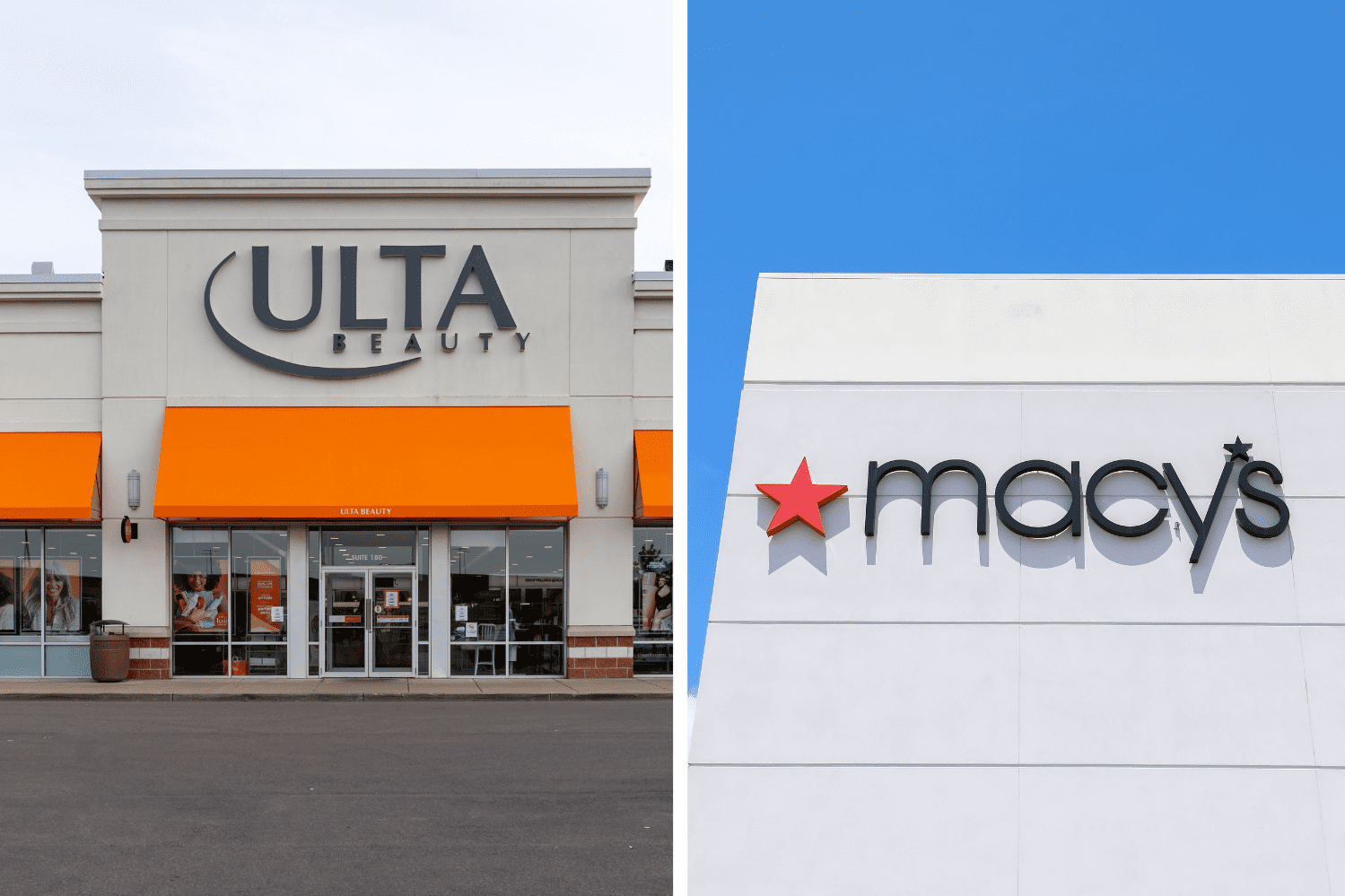
Rising fuel prices, inflation and macroeconomic uncertainty aren’t slowing down spending at Macy’s Inc. and Ulta Beauty, who both reported Q1 results that exceeded expectations.
“The Macy’s Inc. customer who is predominantly middle- to upper-income remained resilient in the first quarter,” said Tony Spring, Macy’s Chairman and CEO on the company’s earnings call on Wednesday. “We found that when the product and the experience are differentiated and compelling, engagement and spend increase.”
In Macy’s first quarter, which ended May 2, net sales grew 1.8% to $4.7 billion, beating guidance and the strongest quarter in four years, according to executives. Comparable sales on a reported basis increased 3%. The company saw consistent traffic and higher average unit retail prices.
Ulta Beauty also reported a strong quarter, which ended May 2, with net sales increasing more than 11% to $3.2 billion and comparable sales growing 5.3%. The beauty retailer expanded its market share in the prestige beauty category and maintained its position in mass beauty. Kecia Steelman, Ulta’s President and CEO, acknowledged the complicated economic backdrop but emphasized the stability of consumer demand.

“The beauty and wellness categories remain healthy, and engagement is strong,” Steelman said during the earnings call adding that Ulta is currently working on a new, “highly experiential” location in Times Square. “At the same time, consumers continue to face macroeconomic uncertainty and inflationary measures and pressures from rising fuel prices, making value increasingly important as a consideration.”
Macy’s Raises Full-Year Outlook amid Strategic Shifts
Macy’s first quarter was largely driven by its “Bold New Chapter” turnaround strategy, Spring said. The initiative focuses on strengthening the Macy’s nameplate, accelerating luxury growth through Bloomingdale’s and Bluemercury and simplifying end-to-end operations.
Macy’s Reimagine 200 program involves upgrading 200 specific Macy’s locations with better assortments, improved visual merchandising and enhanced customer service. These locations achieved a 2.4% comparable sales growth in Q1. Furthermore, Bloomingdale’s achieved a positive 10.2% comp, marking its highest first-quarter sales volume in history.
Macy’s Inc. raised its full-year outlook for fiscal 2026. The retailer now expects net sales of approximately $21.5 billion to $21.75 billion and adjusted diluted earnings per share of $2 to $2.20.
“Customers are responding to our curated product assortments, focused service, targeted messaging and traffic driving promotions and events,” Spring said.
Ulta Beauty Leans into Exclusivity and Omni-Channel Growth
Ulta Beauty’s first-quarter results were fueled by strength in prestige cosmetics, haircare and fragrance, alongside robust mid-teen growth in its ecommerce channel.
The retailer’s strategy centers on offering a diverse mass-to-luxury assortment, expanding its digital capabilities, and building multiple exclusive brands. During the quarter, Ulta launched more than 20 new brands and saw its Ulta Beauty Rewards loyalty program grow to nearly 47 million members. The company also launched a TikTok Shop to spotlight the brands exclusively carried by Ulta and engage younger consumers.
Recognizing the strong start to the year, Ulta updated its fiscal 2026 outlook. While maintaining its net sales growth guidance of 6% to 7%, the company increased its operating income growth expectations to a range of 6.5% to 9% and raised its diluted earnings per share forecast to between $28.36 and $28.80.
Despite the positive results, Ulta executives maintain a measured view of the macroeconomic landscape. The company remains focused on operational discipline and executing its strategic priorities to maintain market share.
“…Last year, growth in beauty grew stronger each quarter as the year went,” Steelman said. “We’re going against stronger growth in the back half, and we expect that growth to really normalize as a whole … The category is still competitive, and we know others are going to be continuing to level up the battle for share, which just means that we’re going to have to be even better as we execute through the remainder of the year.”
Disconnect Between Consumer Sentiment and Spending
According to the Q1 2026 edition of The Reality Check by Attain, a permissioned commerce data platform that connects consumer sentiment with verified, opt-in purchase behavior, there is a widening gap between how consumers feel about money and how they actually spend it.
Nearly half of 6,000 surveyed consumers (46.1%) described themselves as “being more cautious” with their spending in Q1 2026, making it the dominant financial mindset of the quarter. Yet their actual transaction behavior told a different story. That same group posted an overall spend index of 98 and a discretionary spend index of 96, both only marginally below average. More striking still, every spending sentiment cohort increased its spending year-over-year, including consumers who believed they were spending “much lower.” Those consumers actually grew their spending by 21.6% compared to the prior year.
The research reveals an important distinction between two types of spending decisions. When consumers deliberately cut a specific category such as dining out less or reducing entertainment spending, they generally follow through.
According to Attain’s research, restaurant spending declined more than 30% among consumers who named it a primary cutback area, and entertainment spending declined more than 70% among those who flagged it as their main area of reduction. But outside these intentional decisions, consumers have little reliable sense of their overall spending trajectory.
Meanwhile, behaviors that appear frugal on the surface such as using coupons, trading down to less expensive brands, waiting for sales or shopping at lower-cost retailers often function more as spending optimization strategies than genuine pullbacks. Attain found that consumers adopting these behaviors frequently outspent those who made no adjustments at all.
“The most striking finding in our data is that the consumers who said they were spending ‘much lower’ actually grew their spending,” said Attain’s President and COO Ben Kartzman. “We see a more selective consumer who is still spending, but making sharper decisions about where, when and how they spend. Brands and retailers should understand that sentiment alone can overstate the risk of spending pullback, while purchase behavior gives a much clearer picture of actual demand.”