

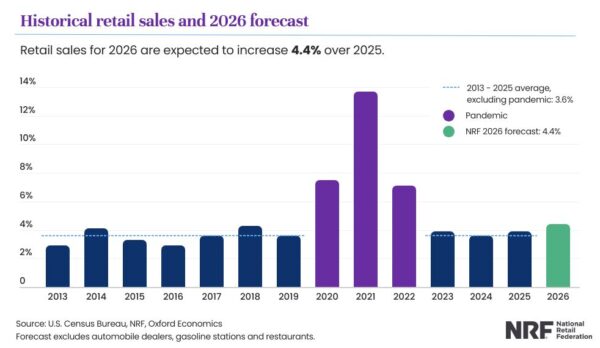
The National Retail Federation (NRF) predicts that U.S. retail sales will increase 4.4% in 2026, reaching a total of $5.6 trillion. Such an increase would outpace the 3.6% average annual growth rate retail has achieved over the past 10 years (excluding the COVID years of 2020 through 2022, when growth was atypical). NRF worked with a new partner, research and analyst firm Oxford Economics, on this year’s sixth annual State of Retail & the Consumer event.
Back in April 2025, NRF had forecast retail sales growth in the 2.7% to 3.5% range in 2025, for a total of between $5.42 trillion and $5.48 trillion, but the year’s actual growth came nearer to 4%, according to Matthew Shay, NRF President and CEO — and the U.S. consumer was a key contributor.
“Consumer spending was a steady and reliable engine of growth in 2025, even as broader economic conditions fluctuated,” said Shay in a statement. “We expect that consumer resilience to continue into 2026, with household spending once again serving as a pillar of economic support.”
“We’re looking at larger tax refunds and the impact of the Working Families Tax Cut Act supporting consumer spending,” said Mark Mathews, Chief Economist and Executive Director of Research at NRF during the virtual event. “There will be a weaker labor market, but I don’t see it impacting the unemployment rate, which should stay below 4.5%.”
As for persistently negative consumer sentiment, Mathews noted that consumers’ attitudes don’t always match their actions: “There’s a disconnect between consumer sentiment and actual spending,” said Mathews. “We expect the solid fundamentals to be the key driver of consumer spending in 2026.”
Bifurcated Economy to Affect Spending Patterns
Despite the rosy forecast, there are certainly areas of concern in the economy. One is the split between higher- and lower-income consumers that will continue in 2026, with the higher end driving the majority of growth across numerous retail categories.
Additionally, the unstable geopolitical situation could have ripple effects on inflation, supply chains and overall consumer sentiment. Mathews noted that the NRF’s forecast doesn’t specifically take into account the impacts of tariffs and renewed conflict in the Middle East, but that the NRF would continue to monitor the situation carefully.