

Key Takeaways:
- Boot Barn posted first-quarter fiscal 2027 net sales of $593.5 million, up 17.7% year over year, beating analyst estimates.
- Comparable sales growth slowed sharply from a 5.4% gain in June to roughly flat in July, with retail store comps turning negative at -1.2%.
- A $14.7 million tariff refund benefit padded earnings per share by $0.38, accounting for a meaningful portion of the quarter’s headline beat.
- Boot Barn opened 27 new stores during the quarter, ending the period with 566 locations across 49 states.
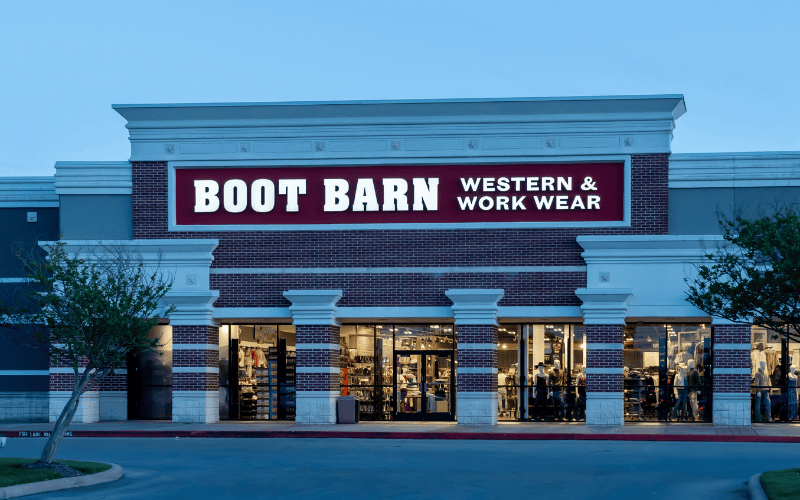
Boot Barn Holdings delivered a stronger-than-expected first fiscal quarter, which ended on July 29, but sales slowed considerably as the company exited the period, particularly among women’s western boots.
The company posted net income of $70.1 million, or $2.29 per diluted share, compared to $53.4 million, or $1.74 per diluted share, in the same period a year ago. Adjusted earnings of $1.91 per share topped Wall Street’s $1.70 estimate. Still, shares fell 4.86% in regular trading to $150.91 on earnings day, suggesting investors were looking past the beat and focusing on softer near-term trends.
Net sales rose 17.7% to $593.5 million from $504.1 million in the prior-year period. Consolidated same-store sales increased 4.7%, with retail store comps up 3.8% and ecommerce comps up 13.4%. Gross profit was $239.9 million, or 40.4% of net sales, up from 39.1% a year earlier.

“July sales did, however, come in below our expectations due to a couple of factors that were not contemplated in our original outlook,” said CEO John Hazen on the company’s earnings call on Wednesday. “We believe fewer western lifestyle stadium events and concerts, together with the temporary impact of World Cup matches on customer traffic during televised games, weighed on our performance during the month.”
Merchandise margin expanded 220 basis points during the quarter. However, 250 basis points of that improvement came directly from tariff refunds, not underlying business performance. Product margin added another 60 basis points, while higher freight expense created a 90 basis-point headwind. Selling, general and administrative expenses were $149.4 million, or 25.2% of net sales, up slightly from 25.1% a year earlier.
Western vs. Work Boots
While men’s western boots increased mid-single digits and men’s and women’s apparel rose high single digits, women’s western boots declined mid-single digits as they cycled tough comparisons from a year ago.
“We break women’s boots down between leather and performance, and where we were seeing the larger slowdown, or the bigger slowdown rather, is on the leather side of things,” Hazen said. “Performance has fared better. We think there’s a little bit of a shift going on from leather to our performance boots.”
Hazen outlined two specific merchandising initiatives heading into the back half of the year. The first focuses on women’s leather boots, a category that saw sharper deceleration in July than almost any other segment. He said the team is working to source more inventory in styles priced around $280 that have been selling well but aren’t widely available across the store fleet.
The second initiative involves women’s denim. Boot Barn recently shifted the in-store floor set for women’s, moving basic core denim to a dedicated wall while positioning more premium styles at the front. The company already made similar changes to the men’s denim presentation last year, and management believes the women’s version will deliver similar results heading into back-to-school season.
Work boots, by contrast, continued to outperform. The category delivered high single-digit comparable growth for the fifth consecutive quarter, and CEO John Hazen attributed that to deliberate merchandising and marketing changes made after he took the top job.
“I am pleased to see the continued acceleration in the work business as the team made a concerted effort to reinvigorate the category last year,” Hazen said on the earnings call. “These efforts include enhancements to our in-store merchandising and increased marketing focus and investments in our key third-party brands to ensure we offer the right assortment for our work customers.”
Analysts pressed Hazen on whether the work boot strength was tied to macroeconomic tailwinds such as data center construction or the energy sector. He said those factors may create pockets of strength at individual stores, but that he couldn’t point to them as broad-based drivers. The strong performance, he said, came from better assortment choices and third-party brand investment, not from oil prices or construction cycles.
“What’s important to note, it was across all geographies again, so there wasn’t something specific around weather in a particular geo or something else going on, oil, et cetera,” Hazen said. “The work business was incredibly healthy.”
Tariff Refunds: A Meaningful, Temporary Lift
Boot Barn received $14.7 million in tariff refunds during the quarter, recognized in cost of goods sold. First-quarter earnings per diluted share benefited by $0.38 due to tariff refunds, said CFO Jim Watkins.
The refund benefit will diminish sharply over the balance of the year. Boot Barn expects tariff refunds to add $2.4 million in the second quarter, $0.7 million in the third quarter and nothing in the fourth. For the full fiscal year, the company projects a total benefit of $17.8 million, or $0.46 per diluted share.
Management said it has modeled the current 10% to 12% tariff rate into its guidance for the remainder of the year and would adjust pricing if rates shift. The company also noted that container shipping costs, while elevated, are well below the levels seen during the COVID disruption years.
Store Openings Continue at a Rapid Pace
Boot Barn opened 27 new stores during the quarter, ending the period with 566 locations across 49 states. The company continues to target 70 openings for the full fiscal year and maintains a long-term goal of 1,200 U.S. locations.
New stores are averaging $3.2 million in projected annual revenue with a payback period of less than two years, according to management. Watkins noted that every store in the chain is four-wall EBIT positive, which provides some cushion against the occupancy cost pressure that comes with aggressive expansion.
Over the past 12 months, Boot Barn’s store count has grown roughly 20%, which creates mechanical deleverage on buying, occupancy and distribution center costs even when individual stores perform well. That pressure is expected to continue.
Ecommerce outperformed stores during the quarter, with comps up 13.4% compared to 3.8% for retail locations. In July, that divergence widened: retail store comps fell 1.2% while ecommerce comps remained positive at 10.7%.
Boot Barn’s approach is what management calls “stores first.” A large portion of ecommerce orders are fulfilled from physical locations, which the company says improves merchandise margins and keeps inventory flowing. Buy online, pick up in store and ship-to-store adoption also continued to grow.
On the customer mix question, Hazen said the split between new and returning shoppers remains roughly half and half, with newer markets such as the Northeast skewing toward a higher share of first-time customers. He said Boot Barn hasn’t seen a meaningful shift in that balance since the fiscal 2022 period when the pandemic drove a surge in new customer acquisition.
Freight Costs and the Price of Oil
Higher freight costs were a headwind during the quarter, creating a 90 basis-point drag on merchandise margin as Boot Barn lapped an unusually low freight expense period a year ago. For the second quarter, management expects freight to flip to a 90 basis-point tailwind as the comparison reverses.
“We’re operating in the same environment as everybody else is,” Watkins said. “We feel really good about the improvement in freight that we’ve modeled in for this year of 10 basis points.” He added that renegotiated contracts with logistics providers have helped offset some of the cost pressure from elevated container rates.
Outlook: A More Cautious Second Quarter
Boot Barn raised its full-year fiscal 2027 guidance, now projecting total sales of $2.58 billion to $2.625 billion, representing 14% to 16% growth over fiscal 2026. The company expects full-year earnings per diluted share of $8.80 to $9.23, including the $0.46 tariff refund benefit.
For the second quarter, Boot Barn expects total sales of $572 million to $582 million and consolidated same-store sales of flat to 2% growth. Retail store comps are projected to range from a decline of 1% to growth of 1%. Earnings per diluted share are projected at $1.55 to $1.65.