

Key takeaways:
- Birkenstock opened new stores in Boulder, Colorado, and West Palm Beach, Florida, marking its Colorado debut and bringing its total U.S. company-owned store count to 22.
- The company is accelerating its own-store retail expansion globally, with 111 owned stores as of March 31, 2026.
- Birkenstock reported fiscal second-quarter 2026 revenue of 618 million euros ($711 million), up 14% in constant currency, though net profit fell 22% year over year amid currency headwinds and U.S. tariff pressures.
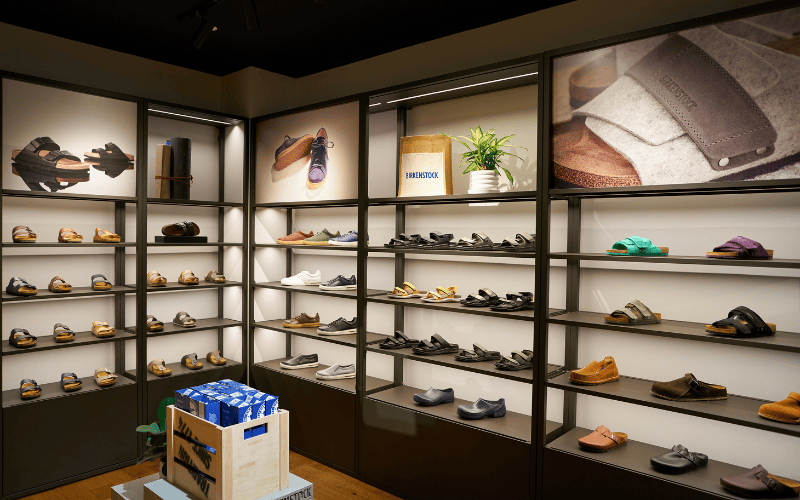
Birkenstock is adding to its growing footprint in the United States. The German footwear brand announced the opening of two new company-owned stores on July 29, 2026: one in Boulder, Colorado, and another in West Palm Beach, Florida. The openings mark Birkenstock’s first retail presence in Colorado and an expansion of its existing presence in Florida.
The two new locations bring the total number of Birkenstock-owned retail stores in the U.S. to 22.
“Opening our doors in Boulder and West Palm Beach is a meaningful step in Birkenstock Americas’ retail journey,” said David Kahan, President of Birkenstock Americas, in a statement. “These two cities embody the values at the heart of our brand: an appreciation for quality and a commitment to living well. We’re proud to bring the Birkenstock experience to both and look forward to becoming part of their communities.”

Each store carries footwear for women, men and kids, including the brand’s core sandals and clogs, as well as sneakers, boots and its Care Essentials collection, which includes a new plant-based nail polish line. Store interiors feature cork, felt and leather, consistent with Birkenstock’s broader retail aesthetic.
Birkenstock’s Retail Expansion Plans Amid Headwinds
The retail expansion is unfolding against a mixed financial backdrop. Germany-based Birkenstock in May reported fiscal second-quarter 2026 revenue of €618 million ($711 million), up 8% on a reported basis and 14% in constant currency, in line with the company’s full-year guidance range of 13% to 15% constant currency growth.
Net profit fell 22% year over year to €82 million ($94.5 million), down from €105 million ($121 million) in the same period of fiscal 2025. The company attributed the decline to unfavorable currency translation, incremental U.S. tariffs and higher finance costs. Gross profit margin came in at 53.9%, down 380 basis points from 57.7% a year earlier.
APAC was the standout segment, posting 30% constant currency revenue growth, compared with 14% in the Americas and 11% in EMEA. The company noted that ongoing conflict in the Middle East created an estimated 300-basis-point headwind to EMEA revenue growth in the quarter.
Despite the challenges, Birkenstock confirmed its full-year fiscal 2026 guidance, projecting 13% to 15% constant currency revenue growth, an adjusted EBITDA margin of 30% to 30.5% and adjusted earnings per share of €1.90 to €2.05.
As of March 31, 2026, Birkenstock operated 111 company-owned stores globally, with 46 in EMEA and 48 in APAC.
“In an overall challenging environment, we continue to see strong opportunities,”said CEO Oliver Reichert in a statement. “Our APAC market is growing at twice the pace of the other segments, we are accelerating the pace of our own retail store openings and our closed-toe share of business continues to expand. We have demonstrated resilience in navigating external headwinds and challenging market conditions, while continuing to deliver strong, profitable growth.”