


When Temu first debuted in the U.S. it was a “China-direct” site, bringing products from overseas factories directly to consumers and boasting incredibly low prices as part of the deal. Over the past four years, though, Temu has evolved into much more than that, opening its platform to U.S.-based sellers (as well as 35 other markets, including the UK, Germany, Japan and Mexico) and its range of price points has widened as a natural result.
The bottom line is that Temu today looks much different than the Temu U.S. consumers were first introduced to in 2022, and it’s not just shoppers who are seeing the difference — U.S.-based sellers are increasingly including the platform in their channel mix.
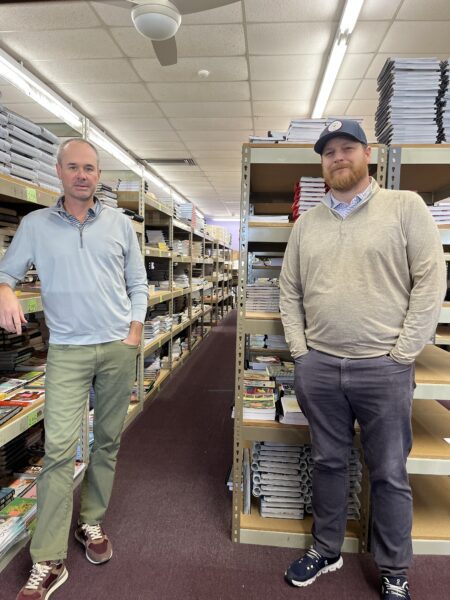
Happy Coil Co-founders (and brothers-in-law) Derek Burt (left) and Scott Forman. (Image courtesy Happy Coil)
One of these is Texas-based bookseller Happy Coil, a family-owned company that sells spiral-bound books. Last year, Happy Coil added Temu to its channel mix, joining the fairly standard seller lineup of DTC site, Amazon, Walmart and Etsy. No surprise, Amazon is a top-performing channel for the company, but what is surprising is how quickly Temu has risen in those ranks. In terms of sales performance, Temu and Amazon are now “neck and neck, depending on the day,” said Derek Burt, VP of Happy Coil in an interview with Retail TouchPoints.
“We started small, with just a few titles, and got traction where and when we weren’t expecting to,” Burt said. “It didn’t take long to see the potential.”

Happy Coil now has 2,100 listings on Temu and has sold more than 53,000 units, averaging around 200 books a day, with the platform now accounting for roughly 40% of its total business.
What makes this growth especially valuable is that it has been driven less by paid advertising and more by the ability to reach a subset of incremental new customers, who are finding Happy Coil’s products organically through the platform’s discovery-based model and then coming back for more, explained Burt.
“We had a book that we couldn’t give away for a long time — it was a chili cookbook,” he said. “But we sold like 40 of these on Temu in July. By any metric you looked at, it was a dying-on-the-vine book, but it found its audience on Temu.”
Happy Coil’s rapid success with Temu highlights some of the core differences between this marketplace and the other U.S.-based mainstays, many of which belie a number of common misconceptions about the China-based platform:
1. Products Don’t Have to Have Bargain Bin Pricing
Temu’s rapid rise in popularity among U.S. shoppers was driven in large part by its incredibly low prices, which the company leaned into in its early days in the U.S., most notably with its “Shop like a Billionaire” Super Bowl spot in 2023.
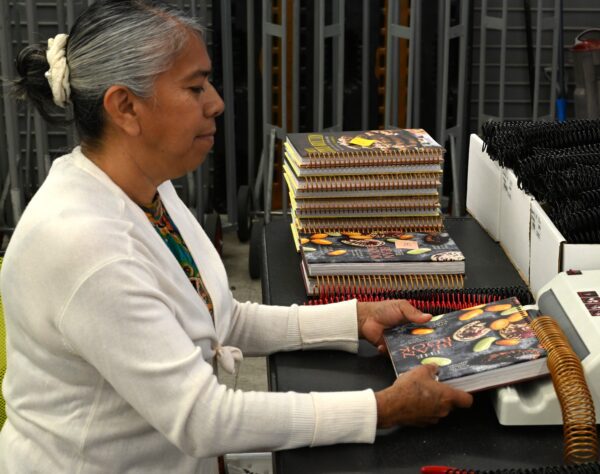
The book coiling process. (Image courtesy Happy Coil)
Now, though, as U.S. brands consider using the platform, one core concern is that their price points may not match Temu shoppers’ expectations. Those worries are likely misplaced, however, as Happy Coil discovered early on.
Spiral binding offers a functionality that is particularly useful in certain kinds of books that benefit from being opened flat, such as textbooks, workbooks, cookbooks and other reference materials: “We tested listing some higher-priced educational books on Temu — test preparation books and certification books, that type of thing,” Burt said. “These are your more expensive, collegiate-level textbooks, and we were very surprised to see sales on those books.”
While these higher-priced books don’t represent the bulk of Happy Coil’s inventory, the company’s average book prices are in the moderate bracket, with most ranging from $15 to $35 depending on the title — still nowhere near those shockingly low prices that first drew U.S. consumers to Temu.
2. Products Come from All Over the World, Including (Increasingly) the U.S.
While Temu still abounds with the factory-direct Chinese products that helped make its name in the U.S., more and more U.S. and European businesses are joining as sellers through the Local Seller program. This program enables domestic sellers to reach buyers in their region, often enabling faster delivery times — a challenge for many China-direct apps, where long overseas shipping times are part of the trade-off for the low prices achieved by cutting out the middle man.
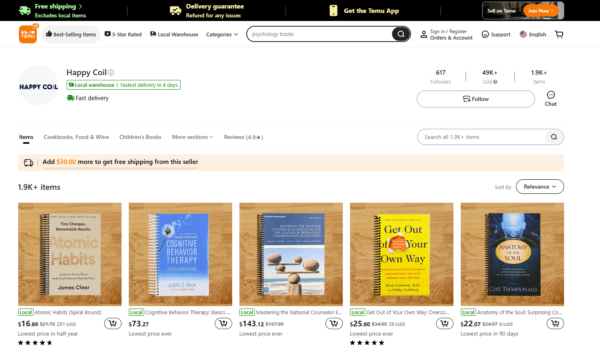
Happy Coil’s Temu storefront. (Image courtesy Happy Coil)
Happy Coil fulfills all of its Temu orders out of its own facility in Texas. “If you were to place an order today, it ships tomorrow,” said Burt. “It’s a pretty straightforward process, although it takes a lot to get streamlined. But we really think it’s important to get the product there in the amount of time that we say we’re going to.”
In fact, reliable, fast shipping is one of the ways Happy Coil is distinguishing itself from the competition on Temu (and there are indeed a number of other sellers in the coil-bound book trade on the platform).
Fulfillment flexibility is a differentiator for Temu as well. Sellers in the Local Seller program can use their own methods and facilities, as Happy Coil does, or utilize Temu’s network of third-party logistics partners, which include USPS and DHL. Quality controls and IP protections also help ensure a trustworthy experience for both U.S. sellers and shoppers.
3. Temu Sellers have more Autonomy than on Other Marketplaces
One of the big differences Burt highlighted about selling on Temu is the absence of a “Buy Box,” like those on Amazon or Walmart.
“Each listing on Temu is independent of a competitive listing,” Burt explained. “So with Amazon, for instance, let’s say you’ve got five sellers selling the same product, it’s all one listing and they have what they call the ‘Buy Box.’ Walmart has the same thing. So [the sellers are] all competing for that Buy Box. On Temu you could have five sellers selling the same book, but each listing is independent from the other, so it gives you more autonomy in the way you structure your listings and your product images; for example, we do all of our own photography in-house.”
This also gives shoppers more choices about who they buy from, and Burt said he’s seen the positive impact of that on Temu: “We try to price our products as competitively as anybody else, but it can be hard to keep up with the market; the dynamics change very quickly. But we’ve seen customers that came back to us, even though we might be priced a little bit higher, just because they had a positive experience.”
Temu also points out that while many other marketplaces are pay-to-play, with sponsored listings dominating feeds, Temu’s discovery-based model gives visibility to sellers with proven quality, value and good service, meaning that even smaller sellers with limited marketing budgets can compete with large advertisers.
Because of this, reviews are a big part of success on Temu. “Temu gets a very high percentage of reviews in comparison to the number of orders,” said Burt. “Those reviews are important [in order] for other shoppers to see that this customer was happy — they liked the book, they liked the seller, they got the book on time, it was a fair price. All those things lend themselves to visibility on Temu.”
4. Onboarding is Easy (Especially if You’re on Shopify)
Burt admits that Happy Coil was slow to enter Temu, in part because the onboarding process for a new marketplace can be intimidating. But in this regard, Temu’s integration with Shopify, which allows sellers to easily bring their catalog over from their website, helped the Happy Coil team quite a bit.
“Now that we can integrate Temu with our Shopify store, we can list products in bulk,” said Burt. “Given the broad category base that we cover, that’s important, because we’re finding that customers that have bought from us before are returning to buy. There’s a lot of single-customer category crossover, so someone might buy a devotional book, a cookbook and a puzzle book in the same order. We really take advantage of Temu’s tools to get as many listings up as we can and into the market.”
Happy Coil also has been helped in the process by a dedicated business development rep who assists with strategy and scaling, something that all sellers have access to.
Marketplaces are Driving Happy Coil Growth
Happy Coil is a relatively new company, having launched in 2024, but now that it’s off to the marketplace races, the sky’s the limit. At the moment the company is taking about 600 to 700 orders every day, and by the end of this year Burt foresees that number bumping up to 1,000, thanks in part to the demand being generated on Temu.
“Frankly, there were a couple companies in our space that were ahead of us [on Temu], so I just wish we would have gotten to it sooner,” Burt said. “For anyone considering [selling on Temu], I would just put aside any misconceptions that you have. I had my own in terms of thinking we were too niche for Temu or there would be no customer base for what we offer or the setup time would be too laborious. None of that turned out to be true.
“Temu’s got wide adoption, it’s got heavy users, it’s got a lot of trust that they’ve built with the American consumer, and I think because of the listing structures and how they work, it’s really conducive for customers being able to find your brand,” he added. “If I could give myself advice a year and a half ago, it would be to lose those misconceptions, don’t be scared and just go for it.”