

Key Takeaways:
- Dick’s Sporting Goods executives say brand-level discounting on legacy sneaker silhouettes will keep the athletic market promotional through the rest of 2026, and they don’t expect a quick turnaround.
- Foot Locker’s integration is proving slower than planned: launch and retro product underperformed in the second quarter, and conflict in the Middle East has weighed on the chain’s European business.
- Newer styles, including Nike’s Mind shoe, are selling out due to manufacturing constraints, while older franchises like traditional Air Force 1 colorways have cooled considerably.
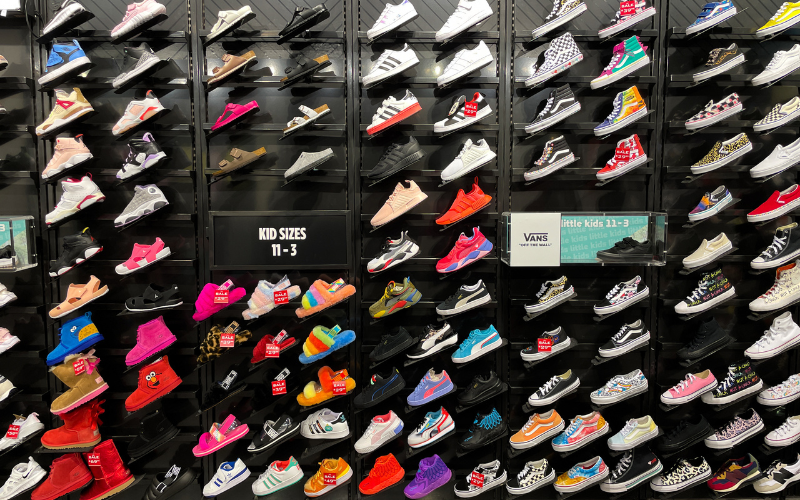
Dick’s Sporting Goods said the sneaker market’s surprisingly promotional second-quarter isn’t going away anytime soon, but that it’s a supply and manufacturing problem, rather than a demand challenge.
Executive Chairman Ed Stack, President and CEO Lauren Hobart, and CFO Navdeep Gupta shared their comments at the Goldman Sachs 33rd Annual Global Consumer and Retail Conference on Monday. Their comments followed the company’s Q2 earnings results, which showed growth at Dick’s but ongoing challenges at Foot Locker, which Dick’s acquired in 2025. Dick’s projects Foot Locker to report a full-year operating loss of $40 million to $80 million, down from a forecast of $110 million to $150 million in profit issued in the previous quarter.
Why Legacy Sneaker Silhouettes Lost Momentum
Much of the pressure traces back to a handful of long-running sneaker franchises that have carried the athletic category for years. Stack said these “legacy silhouettes” slowed more sharply than expected during the second quarter, catching both retailers and brands off guard.

“These legacy silhouettes — they had been trending down, but somewhere in the second quarter, they really slowed,” Stack said.
The slowdown hit Foot Locker harder than the core Dick’s business because of Foot Locker’s heavier reliance on retro footwear. Stack pointed to a supply chain mismatch as the real culprit: too much inventory of aging styles and not enough of the newer product consumers actually want.
“The industry’s got a really interesting problem that is short term, but they’ve got an over capacity issue in some of the legacy silhouettes, and there’s an under capacity issue on some of these new shoes that have come out that are really resonating with the consumer,” Stack said “So there’s an imbalance going on right now, and we’re not able to get more of these shoes in based on manufacturing constraints.”
Asked directly whether the slowdown reflects fading consumer interest in sneakers overall, Stack rejected that concept.
“We don’t see this as a demand issue whatsoever,” he said. “If you’ve got something that’s new and innovative, that consumer is stepping to the plate to buy that product.”
He pointed to Nike’s Mind shoe as evidence, along with updated takes on familiar silhouettes like the Air Force 1. A triple white Air Force 1 in a traditional colorway has slowed considerably, Stack said, but the same shoe in patent leather or a new finish is nearly impossible to keep in stock.
How the Middle East Conflict Is Affecting Foot Locker’s European Business
Foot Locker’s international operations added another layer of pressure the company didn’t anticipate when it set its original full-year guidance. Stack said ongoing conflict in the Middle East has made European consumers more cautious and intensified an already aggressive promotional environment there.
“When we originally gave our guidance for the year of what we thought we were going to do from a Foot Locker standpoint, there was not a war going on in the Middle East, and that has had a really meaningful impact on Europe,” Stack said.
Stack said the company initially aimed to cut about 30% of SKUs across Foot Locker’s assortment but has since determined that more trimming is needed.
“There’s still more editing to be done,” Stack said, noting that even within the top-performing 20% of SKUs, the assortment remains too broad. Narrowing it further, he said, would free up dollars to invest in deeper sizing and stronger colorways of franchises that are already working.
Hobart drew a clear distinction between how the two customer bases are holding up.
“The Dick’s consumer is holding up very, very well, and that’s been for some time, and that’s due to the prioritization of sport and health and wellness,” Hobart said, citing the World Cup as an example of how sport and culture are coming together. “We did not see trade down from best to better or better to good; we saw growth across all income demographics. I think the Foot Locker consumer may be a little bit more under pressure. However, when there is newness and innovation, that’s resonating.”
Pricing and Margins Heading Into the Second Half
On pricing, Stack said to expect a similar approach to what played out in the second quarter rather than a dramatic shift.
“I think the balance of the year will be similar to the second quarter,” he said.
Gupta declined to offer specific 2027 margin guidance but pointed to two priorities shaping the company’s approach: continued investment in initiatives that are already delivering returns, such as the House of Sport format, and an organization-wide push on productivity. He said the team will keep monitoring the pricing and promotional landscape as it builds next year’s plans.
Where AI Fits Into Dick’s Strategy for 2027
Asked about artificial intelligence, Gupta said Dick’s is applying it on two fronts: reducing friction for employees and enhancing the shopping experience for customers. He pointed to Coach by Dick’s, a consumer-facing tool now built into the Dick’s mobile app, as the clearest example of where the company expects the biggest impact heading into next year.
“We are not doing tech for tech’s sake,” Gupta said. “We are doing where we think we can really amplify the strategies.”