
Key Takeaways
- Five retailers across grocery, outdoor apparel, kids’ apparel, farm and ranch and western wear flagged consumer pullback or pricing resistance on quarterly earnings calls held within roughly two weeks of each other.
- The pressure showed up differently at each company, from Albertsons’ lower-income shoppers leaking to competitors, to Tractor Supply’s fuel-sensitive rural customer to Boot Barn’s sales slowing within the quarter itself.
- Kevin Depew, Deputy Chief Economist and Industry Eminence Program Leader at RSM, said the pattern reflects a K-shaped economy in which lower- and middle-income households face real spending pressure while upper-income consumers remain cushioned by equity gains.
Five earnings calls, five unrelated categories, and the same undercurrent kept surfacing: a consumer pulling back, resisting price increases or shopping with more caution than retailers had planned for heading into the back half of the year.
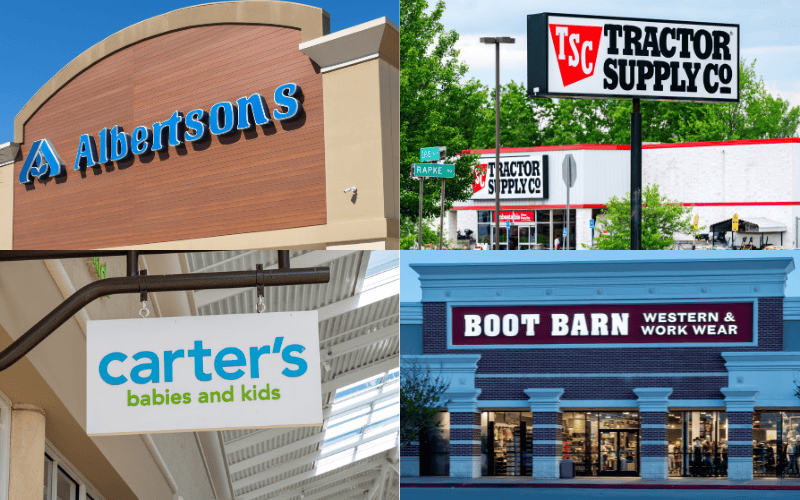
Over a roughly two-week stretch, Albertsons, Columbia Sportswear, Carter’s, Tractor Supply and Boot Barn all flagged some version of this pressure on their quarterly earnings calls. Here is what each company said.
Albertsons
President and CFO Sharon McCollam said the company’s identical sales decline of 0.8% in the first quarter of fiscal 2026 was most pronounced in its lower-income customer segment, in both units and basket size. CEO Susan Morris said those shoppers are leaking to price-focused competitors including Walmart and Amazon, and the company is responding with targeted loyalty offers and price locks rather than broad-based discounting. Albertsons cut full-year guidance across every key metric and pointed to ACI Edge, a restructuring initiative consolidating 11 divisions into four regions, as part of its response.

Columbia Sportswear
CFO Jim Swanson said domestic brick-and-mortar traffic stepped down starting in mid- to late April, which he tied to inflationary pressure from fuel and food prices, describing it as a step function rather than a gradual erosion. Chairman and CEO Tim Boyle pointed to broader economic strain on lower- and middle-income consumers as a factor weighing on discretionary spending industrywide, and said the company expects that pressure to continue affecting demand through the second half.
Carter’s
CFO and COO Richard Westenberger said data from the broader market in Q2 showed consumer resistance to pricing alongside a loss of unit velocity, prompting the company to plan for a more value-conscious consumer in its back-half assumptions. Within Carter’s own numbers, U.S. retail comparable sales growth was driven entirely by units rather than price — average pricing was flat against the prior year. Even with comparable sales up 5.1% for the quarter, the company narrowed its full-year outlook.
Tractor Supply
CEO Hal Lawton said fuel price spikes during the height of the spring selling season hit hardest among a customer base that often drives long distances, frequently in diesel-powered pickup trucks. May alone accounted for roughly two percentage points of the quarter’s 1.5% comparable sales decline, sharp enough that the company withdrew the long-term financial framework it introduced at its December 2024 Investor Day. In-store transaction counts fell 1.7% for the quarter while average ticket grew just 0.2%, pointing to fewer trips rather than smaller baskets.
Boot Barn
Comparable sales growth slowed from a 5.4% gain in June to roughly flat in July, with retail store comps turning negative at minus 1.2%. CEO John Hazen attributed part of that July softness to fewer western lifestyle stadium events and concerts, along with World Cup match broadcasts pulling customer traffic away during games, alongside broader caution among shoppers.
Do Q2 Results Point to a Genuine, Broad-Based Pullback?
Kevin Depew, Deputy Chief Economist and Industry Eminence Program Leader at RSM said the upper quintile of income earners is carrying consumer spending through the wealth effect while lower-income households draw down savings. Real consumer spending rose 0.4% in June, matching an 11-month high, but the savings rate fell to 2.7%, a nearly four-year low, signaling that households are spending rather than rebuilding buffers.
“For retailers it all comes down to which income quintiles are your primary customers,” Depew said. “If it’s at the top, you have a moderate cushion of demand. But if your customer base is in the bottom three quintiles, it likely very much feels like a slowdown with significant pricing sensitivity.”
On the macro drivers, such as fuel prices, food inflation and strain on lower- and middle-income households, Depew again pointed to the K-shaped economy dynamics. Those on the upper path of the K are cushioned from higher prices while households on the lower path have significant exposure to energy and food inflation. The wealth effect compounds the divide: every trillion dollars of equity gains produces roughly $8 billion in direct consumer spending, he said, or about $14 billion once the multiplier is applied. With stock markets near all-time highs, the current rally is worth roughly 30 basis points of growth.
“The risk, of course, is if there were to be a meaningful market correction,” Depew said. “Because we are now in an economy and consumption pattern that is highly levered to equities prices, a reversal has the potential to pull the rug from what has been an increasingly narrow group of consumers.”
On the outlook for back-to-school and holiday, Depew said the spending picture should brighten modestly in the second half as falling oil and gasoline prices bolster consumption among the middle and working class.
“Of course, this is heavily dependent on relief from lower energy prices in the second half,” Depew said. “The risk is that the inflation shock has drawn down savings to a nearly four-year low of 2.7% so there isn’t a lot of margin for error should energy prices re-accelerate.”