
Founded in 1863, The Frye Company is the oldest continuously operating shoe company in America — and one of the key reasons is that its products are built for the long haul. Over the last 160+ years, the company has maintained a reputation for high-quality, long-lasting goods, and Frye continues to lean into that promise, most recently with the expansion of its resale program.

The very first Frye boot circa 1888. (Image courtesy Frye)
Frye was an early mover in resale, having launched its peer-to-peer (P2P) marketplace, Frye Exchange, in 2022. Now, in partnership with resale solution Trove, the company is expanding that program to include Frye Found, which will offer brand-owned resale merchandise alongside that P2P inventory, all within a single ecosystem.
“Frye footwear is designed to age beautifully — the leather softens, character deepens and stories accumulate,” said Todd Dreith, EVP of Ecommerce and Marketing at Footwear Unlimited, the manufacturer and distributor of Frye, in a statement shared with Retail TouchPoints. “With Frye Found and Frye Exchange, we’re standing by our craftsmanship and extending the life of our products beyond initial production, all while deepening our connection with the Frye community.”
Both Frye Found and Frye Exchange live as distinct experiences within Frye’s website, but customers can shop across new, peer-to-peer and brand-owned resale in a single, unified cart and checkout experience.
“Frye Found and Frye Exchange together demonstrate how a heritage brand can deliver two distinct value propositions while expanding reach to complementary customer groups,” said Terry Boyle, CEO of Trove in an interview with Retail TouchPoints. “[This combined ecosystem] is something we haven’t seen elsewhere in the industry. It brings the convenience and ease of traditional retail to resale in a way that hasn’t existed before.”
A Dual-Channel Resale Ecosystem
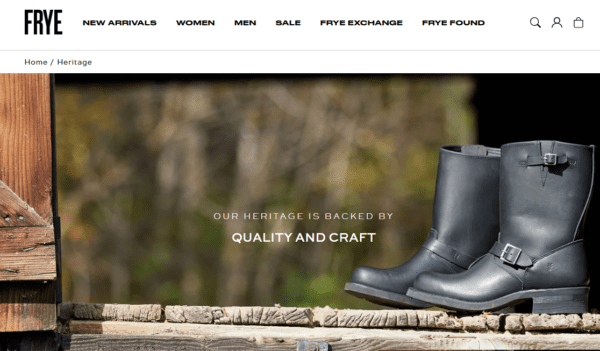
Frye Exchange and Frye Found both have pride of place in the menu of the Frye ecommerce site.
While both resale experiences live within Frye’s existing ecommerce environment, each serves different customer needs: Frye Exchange fosters a community-driven resale experience where customers buy and sell directly with one another; sellers receive payment in Frye gift cards. Frye Found introduces a brand-owned channel to the resale mix, showcasing product sourced directly from the company, including past-season styles, rare samples and high-quality returns.
The varied nature of Frye Found’s product sources can create a “treasure hunt” vibe for shoppers. “With the limited inventory [of Frye Found], each find feels like uncovering a hidden gem,” explained Boyle. “Once a style is gone, it’s gone. Frye has essentially opened the vault to bring customers a curated mix of favorites you won’t see anywhere else, and a small number of gently returned items that still meet Frye’s strict quality standards. Together, [Frye Exchange and Frye Found] give customers more optionality in how they shop resale, while allowing us to maximize the number of items that stay in use and in circulation.”
Returns: ‘One of the Biggest Untapped Profit Opportunities in Retail’
With this expansion, Frye is not only giving consumers more ways to shop and discover its products; it’s also tackling one of merchants’ thorniest problems — returns.
In fact, Frye’s expansion of its resale program reflects a broader shift in how retailers and brands are approaching resale today, said Boyle. “Early on, resale conversations were largely centered around sustainability. Today, they’re much more focused on economics: margin recovery, operational efficiency and how brands handle the growing volume of returns.”
As a result “brands are no longer thinking about resale as a standalone initiative, they’re looking at the entire post-purchase lifecycle,” Boyle added. “Returns used to be treated as a cost center, but they’re now one of the biggest untapped profit opportunities in retail. The real complexity isn’t the resale storefront, it’s what happens the moment a product comes back. You need systems that can quickly assess condition, determine whether an item can go back to stock as new, or route it to the next best outcome, whether that’s resale, marketplace or another channel. It’s all about having a unified system that can manage different inventory types while delivering a consistent customer experience.”
Frye found that system in Trove, which provides the technology, logistics and resale infrastructure to run both programs while maintaining brand standards and customer trust.
Resale that Feels as Natural as Traditional Retail
This shifting view of the business opportunity represented by resale aligns with a wave of consumer enthusiasm for secondhand, prompted both by attitudinal shifts and recent economic pressures. Globally, the secondhand market is projected to hit $393 billion by 2030, growing 2X faster than the overall apparel market. And in the U.S., secondhand sales are already outpacing broader retail by a whopping 4X and are expected to reach $78.8 billion by 2030.
“Frye is a great example of how brands are evolving their resale strategies over time,” said Boyle. “The most successful programs are modular: brands need the flexibility to expand over time, based on their customers and business goals. That’s really the shift we’re seeing across the industry — brands don’t want a single resale solution, they want a platform that gives them multiple paths to grow and evolve their programs over time.
“What’s notable here is the seamless experience,” he added. “Bringing new, peer-to-peer and brand-owned resale together into a single shopping journey reflects where the industry is heading — toward resale that feels as intuitive and integrated as traditional retail.”
And Frye’s circular ambitions don’t stop with resale. Looking ahead, Frye is exploring additional lifecycle services, including refurbishment, to meet growing customer demand and further extend product longevity.