
For decades, centuries even, hotels around the world have operated under the same well-understood principles. Yes, the idea is to make you feel as comfortable away from home as possible, but wised-up consumers all now know that comfort generally comes with a cost: minibar prices will be exorbitant, the lobby is only for people who have business with the hotel or someone staying in it, and the hotel in general is designed for visitors not locals.
The Hoxton, a group of boutique hotels that originated out of London, has set out to break all those rules.
“What makes The Hoxton special is that although we have 19 properties that sit all over the world, each one is unique to that location,” said Portia Mannix, Brand Manager, East Coast and Global Partnerships for The Hoxton in an interview with Retail TouchPoints. “We like to say that The Hoxton is a series of global hotels that are a representation of the diversity and originality of the streets that surround them. We work with local organizations, brands and shops because we want to ensure that we are a hub for that neighborhood. We like to call our lobbies living rooms for a neighborhood.”
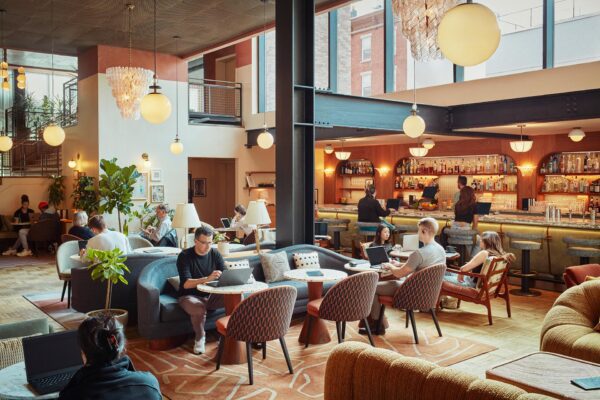
One of The Hoxton lobbies, which are designed not just for hotel guests but weekday warriors who need a place to work and anyone else who wants to just put their feet up. (Image courtesy The Hoxton)
In fact, The Hoxton has gone so far to make their lobbies inviting to the general public that the reception desks are often tucked away in the back. “In Williamsburg, [Brooklyn], we often find people asking, ‘Where do I check in?’ because the public space is what’s front and center, and that’s by design,” said Mannix.
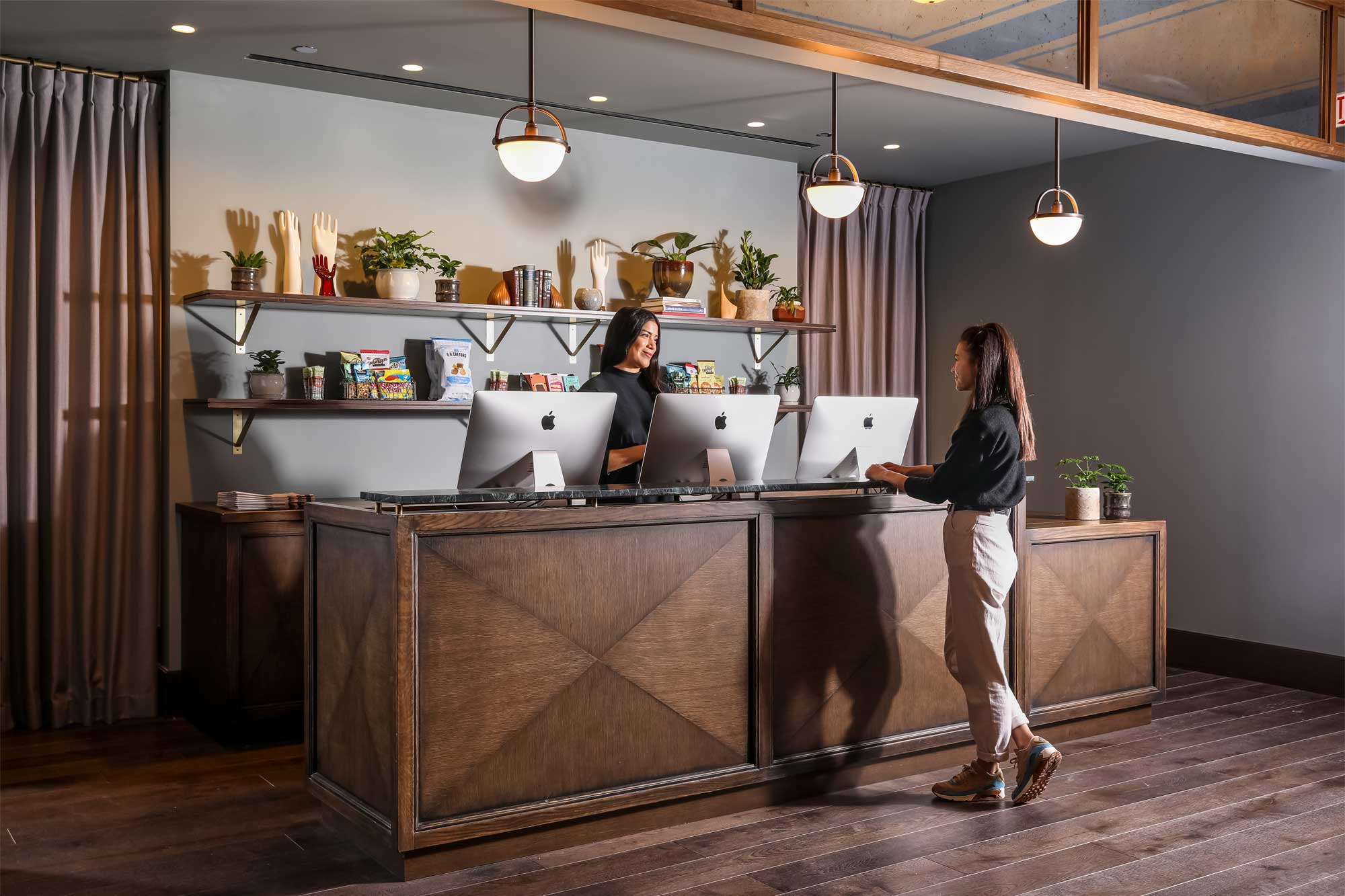
One element that is prominently placed in the chain’s lobbies is the Hox Shop. “Unlike a more traditional hotel offering, we don’t have minibars in the rooms,” Mannix explained. “When I was growing up, I remember I would go to grab the can of Pringles, and my parents would smack it out of my hand and say, ‘That’s $30. You don’t need that.’ At The Hoxton we believe in a no rip-off policy. So instead of having the in-room offering, the Hox Shop is where we house snacks and drinks for guests to come and purchase at supermarket/bodega pricing. If you were to go down the street to a corner store or a Whole Foods, it’s going to be [a similar price, based on] the MSRP.”
Optimizing the Sourcing of Local Products
Hox Shops stock the classics of course — Snickers, Diet Coke and the like — but they also make a point to offer local products and emerging brands, in keeping with the chain’s ethos of representing the neighborhoods its hotels inhabit. “We love to pepper in things that you might not have seen on your shelves at home,” said Mannix.
To facilitate this kind of localized assortment across its U.S. locations, Mannix and her team rely on wholesale marketplace Faire, which they began using three years ago.
“Historically, we curated the snacks by hand, and a lot of that is a pain to facilitate from an operational side,” said Mannix. “A lot of the time, especially for the emerging local brands that we are after, you’re individually emailing those vendors and you’re having to keep a very close eye on your inventory and different lead times. So I started looking for an easier way for us to achieve the goal of having emerging, local, delicious, fairly priced snacks, but not sending our teams down a rabbit hole every other week of reaching out to 20 different vendors and tracking all of that.”
A More Efficient Sourcing Process for Merchants and Manufacturers
Mannix’s experience isn’t unique. Any executive who’s ever managed inventory for multiple regional locations can relate to the complexity of handling the process manually, or even over multiple ordering platforms.
“It’s more efficient for both sides,” said Jen Burke, CRO of Faire in an interview with Retail TouchPoints. “It’s more efficient for retailers to have just one place where they’re managing their communication and invoicing across a number of vendors, but it is also more efficient for that local maker who can [direct buyers to Faire so they] have all their orders in one place and don’t have to manage orders out of multiple systems.”
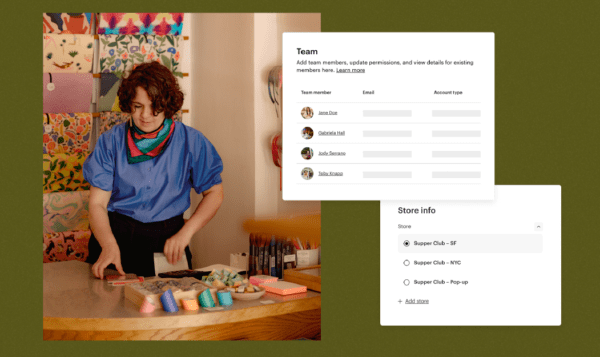
Faire’s new Teams feature allows multiple people to collaborate on purchasing. (Image courtesy Faire)
Part of the reason Mannix and her team are able to manage sourcing for hotels in Williamsburg, Portland, Ore., Chicago and LA all in one place is thanks to a series of new tools Faire has rolled out. Users are now able to buy and ship for multiple locations in one account; add access to that account for multiple team members and manage different permissions for each person; pay via bank transfer (previously all orders had to be paid via credit card); and soon will be able to order via PO.
“We’ve been around for quite some time now, over eight years, and our customers have grown up with us,” shared Burke. “Some customers who are doing all of their buying on Faire have started to open new locations or have hired more employees, so [these new capabilities were] a pressing need to serve our core demographic.
“But as we’ve gotten bigger and added more selection to the site, we’ve just naturally become the destination that a lot of stores want to go to, to buy, because they can’t go to any other channel and see as wide of an assortment across multiple categories,” Burke added. “There’s an increasing desire for them to use Faire but there had previously been limitations for them to use it effectively. So about 18 months ago we started investing in how we help support bigger, multi-location businesses.”
Specialty Stores and Retail Concepts are on the Rise
This comes as the number of specialty stores in the U.S. continues to grow steadily, and these larger retailers are now one of Faire’s fastest-growing segments. Retailers with more than $1 million in annual sales now account for over 20% of order volume on the platform, and that includes not just specialty chains but also museum shops, regional grocers, florists, interior designers and companies like The Hoxton that feature add-on retail offerings.
The investments Faire has made to serve these larger customers build on other existing features that highlight different types of regional or socially focused product categories, as well as personalization tools that make it easy for merchants to find the right kind of products for their business among the millions of items available from over 100,000 brands on Faire.
“It’s been a true gem from an optimization standpoint, because we’re able to maintain those values of finding local products — because on Faire so many of the vendors put where they’re from, where they’re sourcing ingredients, their background, their stories — and we’re able to access all of them at really competitive wholesale pricing,” said Mannix. “And you can shop across everything you need in one destination.”
Faire Foresees More Growth from Here
Mannix and other happy customers like her aren’t the only believers in Faire. Late last year, Faire received a tender offer that valued the business at $5.2 billion.
“Investors looking at our business from a financial standpoint are looking at two things,” explained Burke. “One, do the unit economics make sense? Aare you making money with these customers? But two, how big is this market, and how big can you get? And I think there are two things that they have increasing confidence on. One is that we can serve a bigger customer segment than just the core, local, single-location gift store, because between those two dynamics the TAM [total addressable market] is pretty massive. And the second piece is, are you just a marketplace or are there other legs to the stool? We are building these platform features that brands are using to run their whole wholesale business, and now increasingly, that retailers are using to run their wholesale business.
“Retailers are finding that to continue to compete and evolve, they need to stock their stores with really unique goods, and oftentimes that means hyper-local products that are hard to find elsewhere,” Burke added. “We are increasingly becoming that destination — whether you’re The Hoxton hotel or an Ace Hardware in Georgia trying to find more local gifting products — where, if you have an intent in mind or you just want to browse for local manufacturers, you can do that most efficiently.”