
Key takeaways:
- Shoe Carnival is renaming itself Shoe Station Group effective June 12, 2026, with its Nasdaq ticker changing from SCVL to SHOE.
- The company plans to close 12 to 14 stores in fiscal 2026 and open three to five new Shoe Station locations in fiscal 2027 as part of a two-banner growth strategy.
- Shoe Station Group executives said they plans to pursue acquisitions of other footwear retailers beyond its existing Shoe Carnival and Shoe Station banners.
Shoe Carnival, Inc. announced Thursday that shareholders approved changing the company’s corporate name to Shoe Station Group, Inc., with the change taking effect June 12. The company’s Nasdaq ticker symbol will move from SCVL to SHOE on the same date.
The name change formalizes a strategic shift that has been building since Cliff Sifford returned as Interim President and CEO in late February: a multi-banner model in which Shoe Station serves as the primary long-term growth vehicle while the Shoe Carnival banner continues operating in markets where it holds competitive strength.

The company also signaled it intends to pursue acquisitions of other footwear retailers as part of its growth strategy.
“The new name and new ticker are reflective of our multi-banner strategy with Shoe Station as our primary long-term growth vehicle and Shoe Carnival continuing in markets where it is dominant,” Sifford said in a statement. “We will also seek to expand our business through strategic acquisitions of other footwear retailers.”
A Veteran Returns to Steer the Transition
The strategic overhaul is being led by an executive with deep institutional history at the company. Sifford has been with Shoe Carnival since 1997 and previously served as President and CEO from October 2012 to September 2019, then as Vice Chairman and CEO from September 2019 until September 2021, and as Vice Chairman of the Board from October 2021 until his return to the CEO role.
He was appointed Interim President and CEO in February after Mark Worden departed as President and CEO and resigned from the board, effective Feb. 24, 2026.
The strategic review Sifford completed with his management team in the first quarter of 2026 produced a clear break from the direction the company had been pursuing, including a sharp pullback on the rebanner program that had been a centerpiece of the prior strategy.
The Strategy Behind the Rebrand
Three core findings shaped the new direction.
First, the company determined that both banners should remain permanent, independent parts of the portfolio rather than collapsing into a single-banner operation.
Second, a detailed analysis of customer data, store trade areas, co-tenancy and brand awareness by market revealed only a limited number of additional Shoe Carnival locations suitable for conversion to Shoe Station, representing a significant departure from prior rebanner expectations.
Third, underperforming stores without a viable economic path under either banner will be closed.
As of June 11, 2026, the company operated 426 stores across 35 states and Puerto Rico, with 281 under the Shoe Carnival banner and 145 under Shoe Station.
On the May 21 earnings call, Sifford described two distinct customer segments that make the dual-banner approach logical rather than redundant.
The Shoe Carnival customer tends to be younger, value-focused, and drawn to fast fashion at accessible price points, with particular strength among diverse, urban family households.
The Shoe Station customer skews older and more affluent, shopping for premium national brands, often in suburban trade areas.
“As they grow up and they get better jobs and better income, sometimes we lose them at Shoe Carnival,” Sifford said on the call, describing how Shoe Station is positioned to capture consumers as they move up the income spectrum.
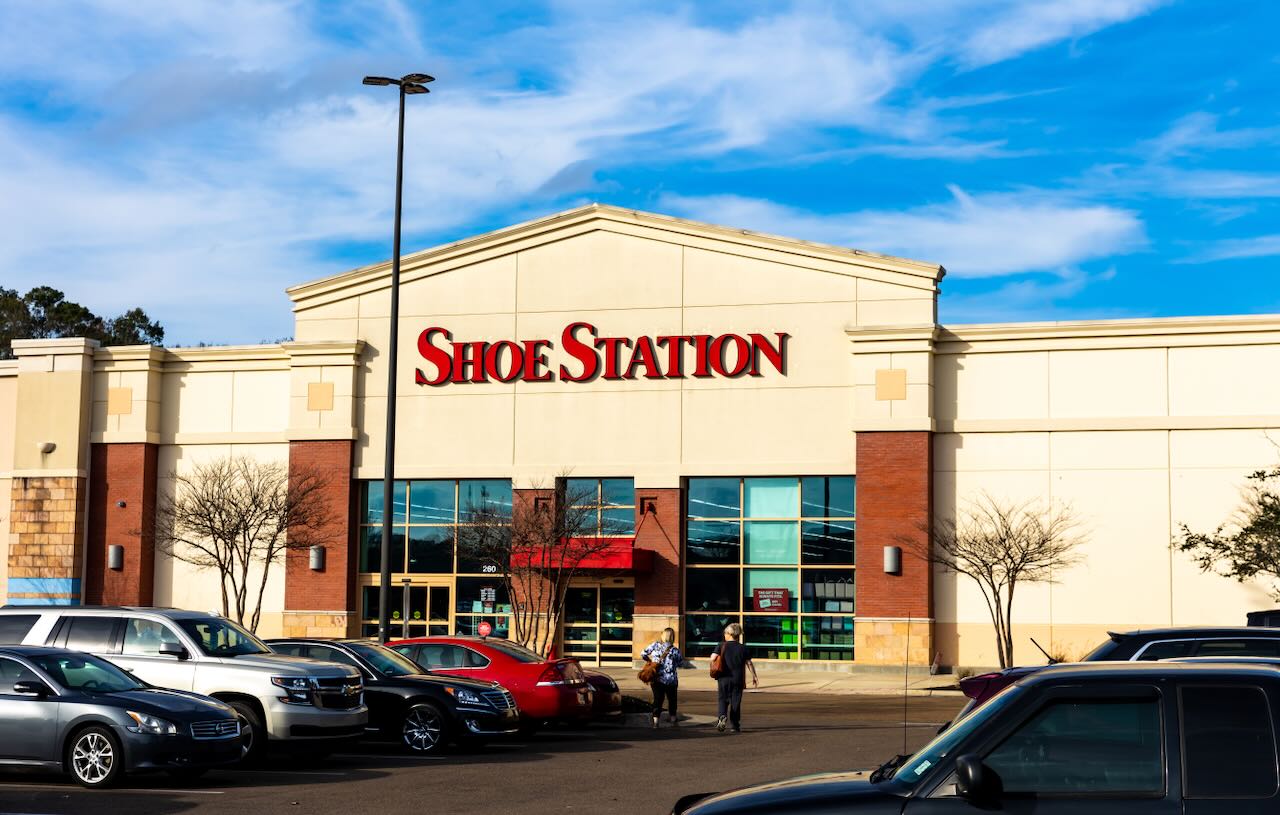
Shoe Station is the company’s primary long-term growth vehicle, according to CEO Cliff Sifford. Photo by stock.adobe.com
Acquisition Ambitions
Beyond organic growth, the newly renamed company has signaled it will look outside its existing portfolio to expand. The name change announcement explicitly states that Shoe Station Group intends to pursue strategic acquisitions of other footwear retailers, a new public articulation of ambition that goes beyond the two-banner strategy the company has been executing.
The financial position to support that ambition appears to be in place. The company ended the first quarter with $129.3 million in cash, cash equivalents, and marketable securities, an increase of 39% compared to the first quarter of 2025, and remains debt-free.
Store Closures and Slowing Rebanners
New store growth will be concentrated under the Shoe Station banner, with plans to open three to five new Shoe Station locations in fiscal 2027, expanding to eight to 10 in fiscal 2028. Those new stores will target suburban trade areas within the company’s existing 35-state footprint where consumer demographics align with the banner’s positioning.
At the same time, the company is pruning underperformers. Twelve to 14 stores will close in fiscal 2026, with an additional six to 10 expected to close in fiscal 2027.
On the earnings call, Chief Operating Officer Marc Chilton said the planned closures are concentrated in the Shoe Carnival banner, with only one Shoe Station location currently slated to close in fiscal 2026.
The rebanner program is effectively complete for this fiscal year, with no additional conversions planned for the remainder of fiscal 2026.
Q1 Results: In Line, With Acknowledged Challenges
The name change arrived against a backdrop of first quarter fiscal 2026 results that met but did not exceed expectations, and an acknowledgment from management that underlying issues at both banners still need to be worked through.
Total company net sales for the quarter ended May 2 were $270.7 million, compared to $277.7 million in the prior year period. Total comparable store sales declined 2.1%.
The Shoe Carnival banner posted net sales of $177.3 million, a 2.2% decline but a meaningful improvement over the mid-to-high single-digit comparable sales declines the banner reported throughout fiscal 2025.
Shoe Station net sales were $93.4 million, a 3.1% decline, with comparable store sales down 2.9%.
On a GAAP basis, the company reported a diluted loss per share of $0.21, reflecting $13.6 million in pretax charges tied to the CEO transition and the strategic review, including impairments at seven store locations and write-offs of rebanner-related fixed assets.
Excluding those charges, adjusted diluted earnings per share came in at $0.23, consistent with consensus analyst expectations. Gross profit margin was 33.3%, down 120 basis points from the prior year.
Where the Merchandising Went Wrong
Sifford and Chief Merchandising Officer Tanya Gordon were direct on the earnings call about what went wrong at both banners.
At Shoe Carnival, merchandising drifted toward higher price points that did not serve the banner’s core value-focused and fast fashion customers, particularly in large metropolitan markets.
At converted Shoe Station stores, the problem ran in the opposite direction. A uniform assortment calibrated for the banner’s legacy Southeast customer base did not resonate in markets where the underlying trade area still reflects Shoe Carnival demographics.
Applying a one-size-fits-all premium assortment to locations whose shoppers were not yet Shoe Station customers proved to be a miscalculation.
The macro environment added pressure. Softness was consistent across all four major footwear categories in the first quarter: adult athletic, men’s nonathletic, women’s nonathletic and children, each down low single digits.
Sifford said on the call that core Shoe Carnival customers are absorbing higher costs for fuel and food, and that challenging trends have continued into May.
The Assortment Reset
Gordon said the merchandising team is now working store by store to calibrate assortments to match actual local demand, a departure from the standardized buying approach applied across the fleet.
About 60% to 65% of the assortment is anchored by national brands common across banners, but the penetration of individual brands and the depth of value-priced product will vary by location.
“We got away from our localization,” Gordon said on the call. Athletic category corrections for Shoe Carnival are targeted to be in place for back to school, when athletic product represents approximately 70% of the business.
Nonathletic and boot assortment changes will be more visible in the Fall season.
Guidance Reaffirmed
Despite the headwinds, the company reaffirmed its fiscal 2026 guidance: net sales of $1.125 billion to $1.147 billion, and adjusted diluted EPS of $1.40 to $1.60.
Management expects the first half to be down and the second half to improve, with back-to-school and fall representing the bulk of the annual earnings opportunity.