

This article first appeared in our sister publication Shop Eat Surf Outdoor (SESO)
Since entering the U.S. market in 2018, JD Sports has transformed from a newcomer into a $6 billion player in the region by acquiring Finish Line, Hibbett Sports, Shoe Palace and DTLR.
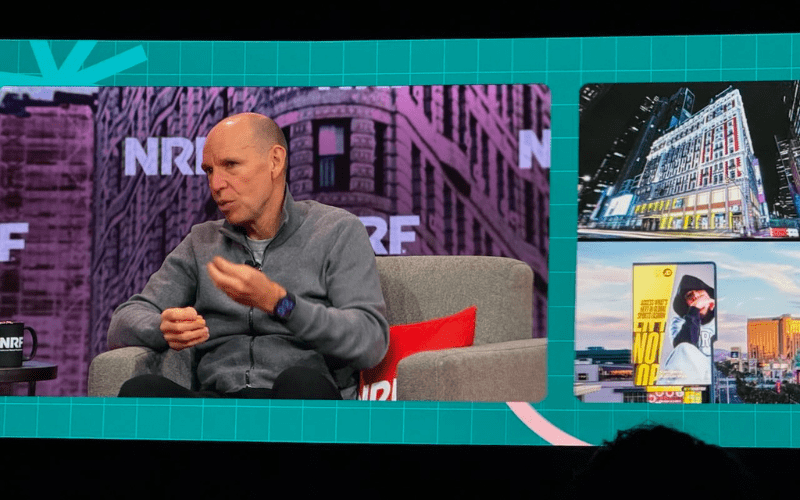
With several years in the U.S. market under his belt, Régis Schultz, the CEO of UK-based JD Group, offered a candid assessment of the American retail landscape in a talk with Fortune’s Phil Wahba at the NRF Big Show in January.
His diagnosis? For too long, U.S. retail buyers have been passive, functioning more as supply chain endpoints than curators of culture.

Retailers Need a Perspective to Survive
When JD Sports acquired Finish Line in 2018, Schultz said he and his team encountered a buying culture that was fundamentally different from their operations in the UK. According to Schultz, the traditional U.S. buyer wasn’t really buying at all — they were merely receiving.
“Our big surprise in the U.S. was that we felt that the market and especially the team were not buyers,” Schultz explained. “They just were people that take the input from the brand and put that in the store.”
For JD Sports, this passive approach was a non-starter. Schultz insists that a retailer must have a perspective to survive. It isn’t enough to simply be a “door” for major brands like Nike or Adidas to push their inventory through. If a retailer acts only as a logistics partner, they become obsolete the moment a brand decides to go direct-to-consumer.
“You need to have a point of view,” Schultz said. “You need to say this is the key seller. This is the color of the month. This is the way we want to do things.”
This philosophy has fundamentally shifted how JD Sports operates its acquired American banners. By retraining teams on merchandising and empowering them to curate offers based on consumer insights rather than brand mandates, JD has earned the respect of the industry’s giants, Schultz said. He also noted that even Nike CEO Elliott Hill has acknowledged JD’s understanding of the customer, telling the retailer, “You know the consumers better than we know them. Please give us the insight.”
The Theater of Retail
Schultz described the typical American footwear shop as uninspired: “A long wall with plenty of shoes… and guess what, there is no story.”
In contrast, Schultz said JD Sports treats its physical locations as “theaters.” The goal is to create energy and excitement that digital channels cannot replicate. This involves significant investment in visual merchandising and hiring staff who authentically represent the customer base.
“Our store looks modern, they have energy, it’s a theater,” Schultz said. “It’s a very different experience for the consumer.”
Understanding the “Sneakerization” of Fashion
Driving JD Sports’ growth is a macro trend Schultz calls the “casualization” of fashion. Sneakers are no longer just for the gym; they are the dominant footwear for daily life.
“Sneaker is becoming the shoe,” Schultz noted, pointing out that sneakers have moved from 30% of the global footwear market to around 50%, with the U.S. sitting even higher at 60%.
However, Schultz is careful to distinguish JD’s lane. The company is not chasing the hyper-technical runner who needs carbon-plated shoes for a marathon — a niche market he believes is best served by specialty retailers or direct brand sales. Instead, JD focuses on “athletic leisure.”
This is the sweet spot where sport meets fashion. It’s about the “head-to-toe look,” where a customer buys a pair of New Balance or Nikes not to run a 5K, but to look good while hanging out with friends. By focusing on this fashion-forward consumer, JD avoids the pitfalls of technical obsolescence and leans into trends like retro basketball and retro running styles.
A Varied Approach to M&A and Expansion
JD Sports’ U.S. strategy hasn’t just been organic; it has been fueled by a “buy-and-build” approach. Since 2018, the self-proclaimed “King of Trainers” has grown from a virtual unknown in the U.S. to an industry player by strategically acquiring major regional retailers — including Finish Line, Shoe Palace, DTLR and, most recently, Hibbett.
The acquisition of Finish Line in 2018 put JD on the map nationwide; Shoe Palace (2020) provided reach and cultural connection on the West Coast; DTLR (2021) deepened roots in urban and community-focused streetwear on the East Coast and Mid-Atlantic; and the Hibbett deal (2024) brought more than 1,100 neighborhood-focused stores largely in the Southeast and Midwest into the fold.
However, Schultz emphasizes that they don’t simply “JD-ify” every brand they buy. While most Finish Line stores will be converted to JD locations, the other banners are largely remaining intact.
Keeping Buying Teams Separate
Schultz argues against the common industry mistake of consolidating buying teams to save money. “The worst thing which has been done in our industry is to say, ‘I keep two brands and have one buying team,’” he said. “It doesn’t make sense because you need to have some things that look different for the consumer.”
JD Sports is in the process of converting many Finish Line stores to the JD banner. Currently there are approximately 400 JD Sports stores in the U.S. with about 120 more Finish Line stores to be converted. In this case, JD does use one buying team because the stores are changing to JD Sports banners.
But they maintain separate buying teams for brands like Shoe Palace and Hibbett to ensure the product mix remains relevant to those specific demographics.
AI and the Future of Customer Interaction
Like every major retailer, JD Sports is integrating artificial intelligence, but Schultz views AI as a tool for seamlessness rather than just a buzzword. The company recently announced new AI tools designed to streamline the customer journey, ensuring that if a shopper starts a conversation with an AI chatbot, they can finish the transaction there without being bounced to a different channel.
Beyond efficiency, Schultz sees AI as a way to enhance the “cool” factor of the shopping experience. He envisions tools that allow customers to take a picture of a shoe in-store and instantly visualize how it matches with items they bought 10 days ago, or how it fits into their existing wardrobe.
“It’s all about being part of the journey to test, to learn and to build the partnership with those technology providers,” Schultz said.
He views this technological adoption as a survival mechanism. If retailers don’t stay relevant and add value to the consumer, they risk being cut out of the equation by brands and technology alike, he said.